Quanta, Obsidian to Co-Develop Thermal Imaging Solutions
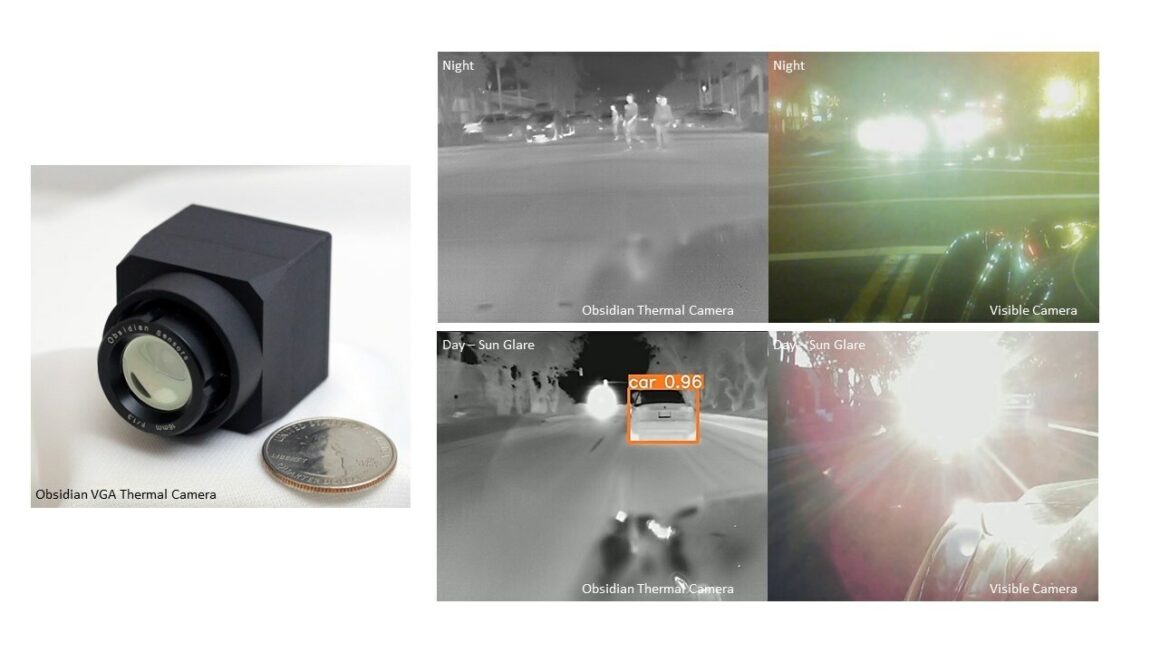
Quanta Computer, specialists in advanced computing technology, is partnering with Obsidian Sensors to produce high-resolution thermal imaging cameras for automobiles.
Obsidian makes high-resolution thermal sensors at low cost and high volume on LAMP (Large Area MEMS Platform), manufactured at established flat-panel foundries. With large glass substrates capable of producing sensors with VGA-or-higher resolution at volumes exceeding 100 million units per year, Obsidian aims to drive the adoption of this technology into the automotive industry, as well as other areas such as security, surveillance, and drones.
“We are developing imaging system solutions with both visible and infrared camera technologies,” said Alan Chai, Senior Vice President of Quanta Computer. “The collaboration with Obsidian enables the fusion of RGB and LWIR sensor signals using AI vision processors to trigger systems such as AEB (Automatic Emergency Braking) and in-cabin vital sign detection. This combination will also advance machine vision products including automotive and professional surveillance.”
Obsidian CEO John Hong says he intends the partnership to introduce his company’s thermal imaging solutions into the automotive market: “Our manufacturing method is scalable to meet the cost and volume requirements of the automotive industry. Thermal imaging is important for improving automotive safety, especially for pedestrians at night. Our sensors make this feasible at scale”.
US regulations mandating that pedestrian AEB systems be installed on all new vehicles starting in 2029 as a standard feature. Although that regulation is being contested by auto industry groups, who may find a receptive audience for their objections in the Trump administration, traffic safety authorities around the world have been looking for solutions to address the rise in pedestrian injuries and deaths in recent years, especially in low light conditions. ADAS and AEB systems benefit from thermal sensors’ ability to see in complete darkness and through challenging weather conditions.
VGA-class thermal imaging cameras with GMSL connections, jointly designed by Quanta and Obsidian Sensors, have been demonstrated at Autosens USA 2024 in Detroit.
DVN comments
Range relates to stopping distances, which increase with speed. Field of view is also important. Therefore, Obsidian will take advantage to advance the resolution of cameras by the development of new formats like SXGA (1,280 × 1,024 pixels) in this bolometric (8-14 µm) technology.
Adasky, Imagry to Put Thermal Imaging Into AI Platform
Imagry, specialists in HD-mapless autonomous driving technology, have been collaborating with Adasky, specialists in thermal cameras. The partnership integrates Adasky’s advanced thermal imaging technology into Imagry’s vision-only AI-driven autonomous vehicle platform, setting a new benchmark for safe, reliable driving in adverse visibility conditions after dark.

Thermal imaging cameras from Adasky can detect a pedestrian crossing a road with his bicycle at night, revealing hazards invisible to visual spectrum cameras and ensuring safer autonomous navigation in low-visibility conditions
Combining Imagry’s visual spectrum AI driving system with Adasky’s infrared spectrum thermal imaging cameras ensures safer L3-4 autonomous driving. Adasky thermal cameras can detect objects and classify living beings at distances that significantly surpass the nighttime detection range of typical daytime cameras reinforced with low-beam headlights. The integration of thermal imaging enables Imagry’s AI Driver to ‘see’ in complete darkness and extreme weather, ensuring safer navigation in real-world scenarios.
This collaboration further improves Imagry’s vision-based HD-mapless driving platform, which relies on real-time visual spectrum camera-based perception and imitation learning to adapt to dynamic environments. With the addition of thermal cameras, Imagry’s platform features enhanced capabilities in night and extreme weather driving. The result: safer autonomous driving solutions for passenger vehicles and public transportation, irrespective of lighting conditions.
Dr. Ilan Shaviv, Imagry’s Chief Technology Officer, says the collaboration will bring advanced thermal imaging into their autonomous driving system: “This integration allows our AI Driver to confidently navigate situations with compromised visibility, such as low-light or rural night driving. With this collaboration, we’re making driving safer and more reliable for everyone sharing the road”.
The side-by-side images shown here compare what a standard visual camera captures at night with the headlights on (left) with what Adasky’s thermal camera reveals (right). These images demonstrate how thermal imaging enables vehicles to detect and classify objects, living beings, and road hazards with unmatched clarity in dense fog and complete darkness.
DVN comments
LWIR thermal cameras improve vehicle perception in dense fog and low-light settings, like rural roads at night. Increasing pixel count is essential to match visible cameras’ performance in detecting small objects at long distances. Even if Imagry’s AI is effective, high resolution and sensitivity are essential.


