By Paul-Henri Matha
I took time some weeks ago to dig into the new Tesla Y with a lot of new lighting features. During my trip to Shenzhen I stopped in at a dealer to check details and be 100-per-cent sure.
Front signature: The Tesla Y has design aspects similar to the Cybertruck, with a full-width lighting signature. All videos and pictures released so far show only the position light function active. But it looks like the same in DRL mode—I checked for myself. Only the light intensity (and therefore luminance) changes. What is difficult to see in pictures, especially due to the PWM used for LED dimming, which makes flickering videos, is that the full-width light bar has different luminance intensity. Only a small rectangle, represented in yellow below, is bright with high intensity; I estimate 400 cd. The rest of the array, here in blue, has low intensity, I think around 50 cd.

It may be designed this way to comply with UN Regulation 148, though solutions are possible.
- By day, both DRL and front position lamps are lit. The DRL intensity minimum requirement is done by the high intensity area (yellow in the diagram here). To reach the required 25-cm2 surface, the low-intensity area is also part of the DRL. The center lamp is only a position lamp to meet the 600-mm separation requirement between left and right DRL.
- By night, the position light function is done by the entire array. The blue-area intensity is reduced by around half, as I saw when I turned the stalk from DRL to position lamp during daytime. The yellow-area intensity is reduced much more; I estimate 1/10.
In China, it may be possible (starting from 1 July) to have from a class-A2 front position lamp with a light intensity similar to a DRL by day, without a 600-mm distance requirement between left and right lamp. Perhaps this new A2 regulation is use by Tesla on this model, but I don’t think so; it would be not valid for Europe. With such a design with low/high intensity, I think it is also useless.
This is also possible in USA with the front decorative lamp feature (though this what I saw on the Y may or may not be compliant with the relevant SAE standard, J3098).
The front turn indicator is part of the upper signalling lamp array, in a small cavity inside the DRL/position light function; that’s the yellow area in my schematic. In USA, due to the steady-burning requirement for position lamps when turn indicator is active, the position lamp cannot be turned off during turn signal operation. This creates this behaviour you can see below; we can recognise this as a probable US model by the side marker light in the lower lamp. This turn indicator fulfills the US EPLLA requirement of 22 cm2, though it’s a bit difficult to see in the picture. As with the 2.5-times-higher minimum front turn signal intensity (≥500 cd instead of ≥200 cd on axis) if the front turn signal is within 100 mm of the DRL or low beam, similar requirements exist with the front decorative lamp if the DRL or front decorative lamp is not switched off during adjacent turn signal operation and that same distance is below 100 mm—which is the case on the Tesla Y.
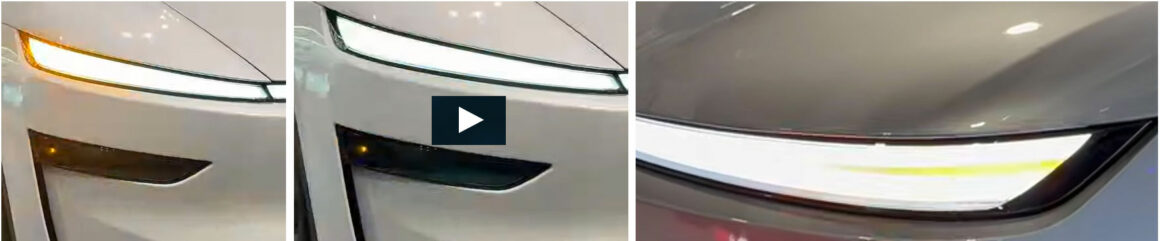
I checked in China, looking at the position light mode and DRL mode: when the turn indicator is on, the adjacent white functions are still on around the turn indicator, but the common apparent surface (the yellow part in my schematic) is off.
Functions are partially optically incorporated, which means some particular provisions in UN R48 apply: when the turn indicator is operating, the rest of the DRL light intensity must be below 140 cd according to R48 ¶ 6.19.7.7.2.b. Looking again at my schematic, the yellow part in this case is the turn indicator (minimum 250 cd) and the blue part is dimmed DRL below 140 cd as required by the regulation.
Extract of UN R48-08:
6.19.7.7 If a front direction-indicator lamp is reciprocally incorporated with a daytime running lamp, either with:
6.19.7.7.2 Partially common apparent surfaces, the electrical connections of the daytime running lamp shall be such that (…)
(b) For category 1a or 1b front direction-indicator lamp the daytime running lamp function on the relevant side of the vehicle is switched OFF for the part of the apparent surface in common with the one of the front direction indicator lamp and the luminous intensity of the part of the apparent surface not in common is reduced during the entire period (both ON and OFF cycle) of operation of the front direction-indicator lamp, to attain not more than 140 cd within the angles of geometric visibility. The conformity to this requirement shall be verified at the time of the daytime running lamp type approval and indicated in the related communication form.
Low beam and high beam are part of the bumper lamp. Matrix headlamps seem to be available according to some media reports, with similar technology seen on current Tesla 3 Highland.

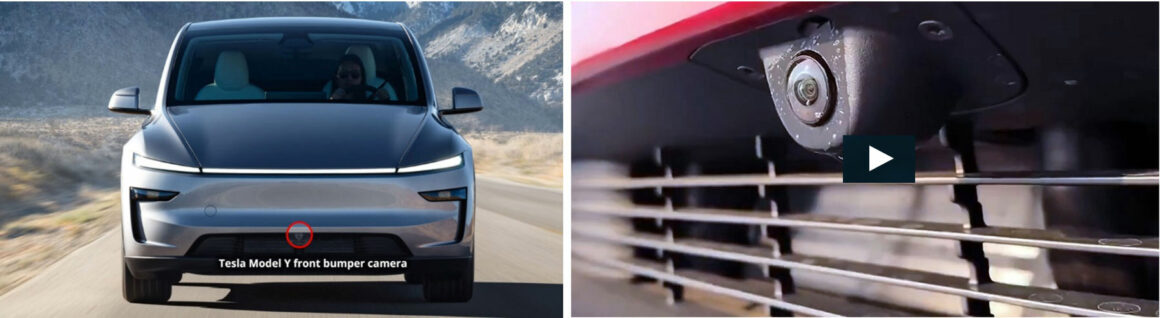
The front camera in the lower grille is equipped with a cleaning system, similar to the Cybertruck.
About the rear, “Model Y had a glow-up. The first indirect reflective body-panel taillight of its kind,” Tesla posted on X via its official account.
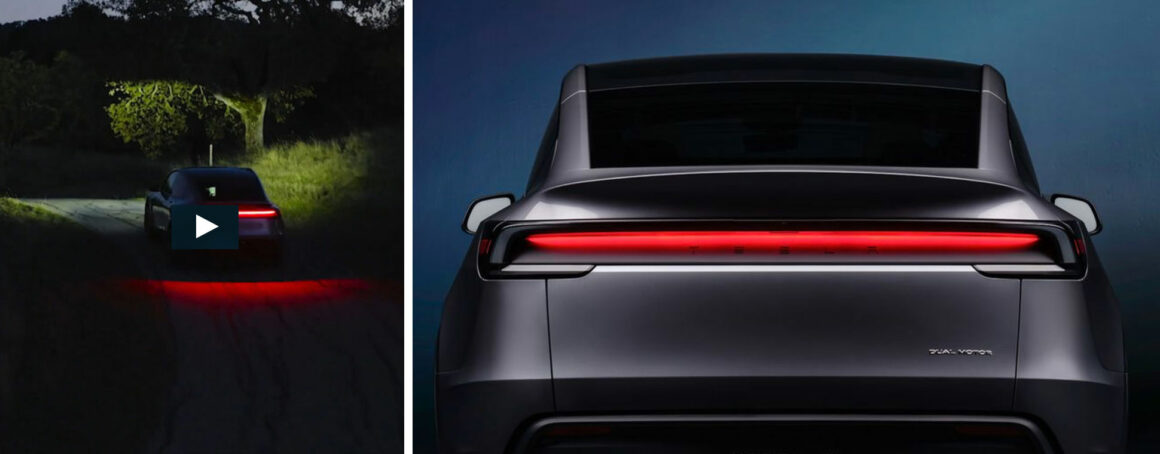
How does it work? the tail lamp is on the tailgate only. Light is aimed downward and reflects on the angled panel, which also has a tesla callout. So we do not see the apparent surface of the position lamp in the X-view. The side marker lamp is done by a dedicated light source on the side.

Is it allowed to project light on the ground? this is not an easy question to answer. For Europe, in UN R48 (lighting and light-signalling fitment), there is no requirement about projection and light intensity. In R148 (light-signaling device requirements), there is a limit on maximum light intensity at ¶ 4.8.3.1.b:
4.8.3 Luminous intensities
4.8.3.1 If not otherwise specified, the intensity of light emitted by each of the two samples supplied shall (…)
(b) In no direction where the lamp is visible, exceed the maximum, specified in the table of the pertinent function in paragraph 5
In this case, maximum light intensity should be 17cd for a class-R1 (single-intensity) rear position lamp. If we estimate lamp height at 750 mm and a distance of glow at 1.5 m, it gives an estimated illuminance of 4 lux, that makes it visible.
However, does this criterion apply?
R148 says “visible”. What is the definition of ‘visible’? the apparent surface of this lamp is not visible, what we see is indirect light. Also the road projection comes from a part of the lamp that is not visible in the visibility angle area (regulated visibility angles extend to 15 degrees down; the Tesla projection is at 30 degrees down).
Secondly, the criterion is for the component, the device, the lamp. What we see here is a reflection of the light from the device. Vehicle installation is part of R48 and there is no mention in vehicle installation for such a requirement if I am correct.
Lastly: what about driving conditions? It was rainy the day I saw the car. How does this setup do with reflection from rain, dust, snow…? Not an easy question. This requires complex validations.

Other signaling functions: stop lamps and turn indicators are all on the tailgate. When the trunk is open, you can see additional lamps for turn, stop, and tail.


Last but not least, lighting controls: the turn indicator control is back on the steering wheel. Flash-to-pass is not on stalk but on a button (first time I see something like this). All other controls—position lamp, low beam, automatic high beam etc—are on the central display. ADB was proposed on the car.

The launch edition is equiped with a puddle light in the rocker panel.

For a flashy look at the Model Y lighting system, take a look at this video from Tesla
To read more, you need to log in as a DVN Lighting member.
Not a DVN member yet? Contact us now to join the DVN Community!


