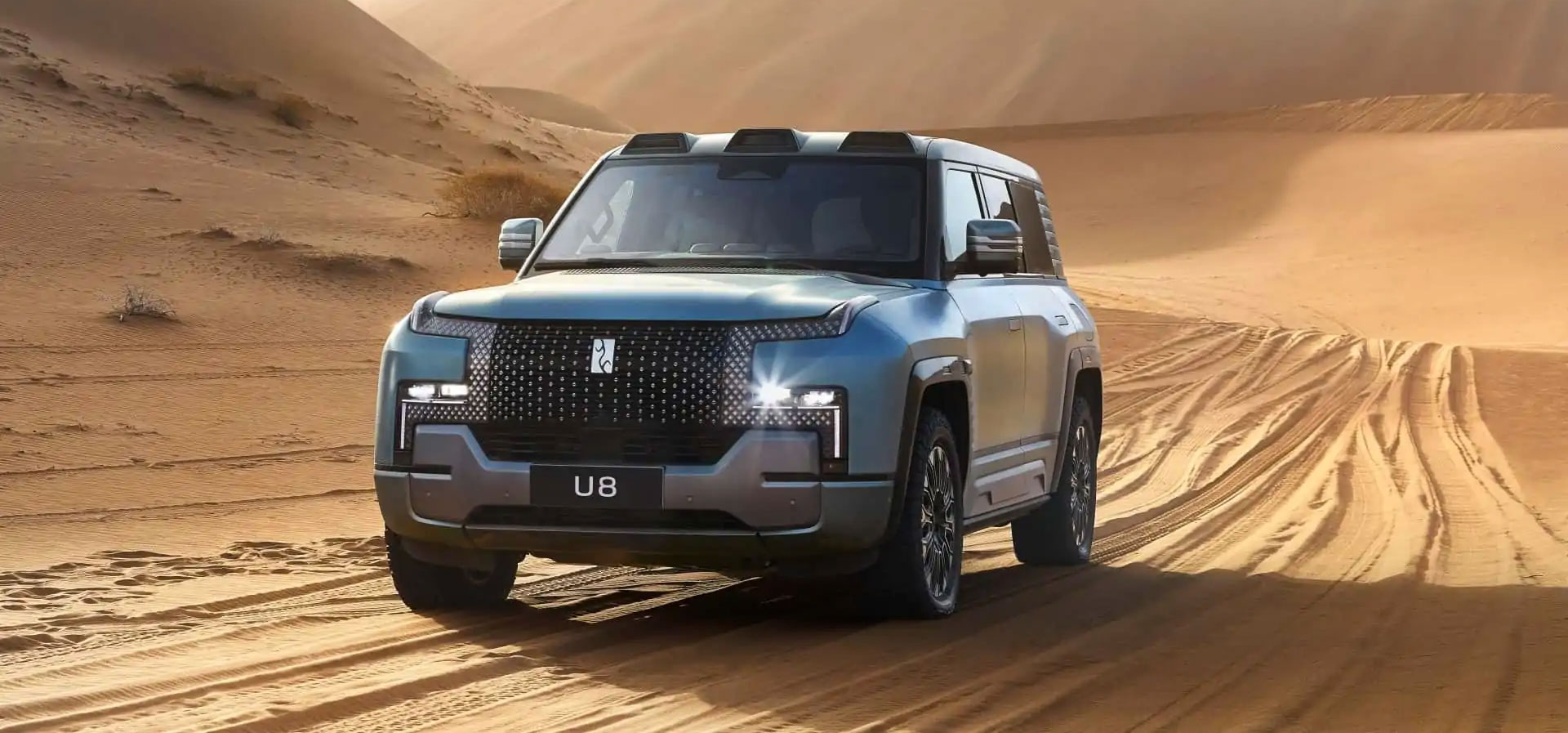
BYD recently announced that it will offer its “God’s Eye” driver assist system on all new models, including the Seagull, priced as low as $10,000. BYD sold over 4M vehicles in 2024, including 400K overseas.
The ADAS system has three variants with different capabilities – the C (DiPilot 100) uses cameras and radar only, the B (DiPilot 300) adds one lidar and the A (DiPilot 600) uses 3 forward facing lidars for fully automated driving. The DiPilot hardware is Nvidia Orin N or X-based and the number represents the AI performance (TOPS). A Horizon Robotics processor is also used in the 600 system. Hesai recently won a new contract to supply lidar to BYD.
The base system has 12 cameras, including a front tri-ocular camera with 2x 8MP stereo cameras and an 8MP telephoto camera. There is also a forward plus 4 corner radars and ultrasound sensors. The system is activated by a separate paddle switch behind the steering wheel. The system can be used for highway pilot (lane-keeping, on/off ramp) up to 100km/h and partial autonomous driving is possible through route learning of common routes. After it learns the route – it can do it autonomously. Limiting the base system to “learned” routes reduces the size of the AI model and the amount of compute hardware required to support it. The system will start and stop at traffic lights and intersections. The system also supports full self-parking and provides valet parking (so you don’t have to be in the car).
The B system adds a lidar above the windshield and a more powerful compute which allows the system to see beyond the headlights and provides more reliable data capture versus camera only in other environmental conditions. The system can drive autonomously under more conditions versus the base system.
The flagship A system uses 3 roof mounted Lidars on the Yangwang models – creating denser point cloud and allows complete driverless operation, including city driving. BYD has also demonstrated its capability on the racetrack, even at night. China does not currently allow hands-off, so hands-on have to be there at all times. Huawei, Nio, XPeng and others are also offering a FSD system. Tesla FSD is currently not fully released in China due to insufficient training data on Chinese roads.

BYD has one of the largest ADAS/AD engineering teams in the industry and the ADAS software was developed in-house. The software is an end-end based AI model (no rules based driving) and uses the DeepSeek model as part of its AI architecture. All new BYD vehicles have the hardware installed, so the software is a free OTA update. One of the key goals of this software release was to reduce the number of false positives of the previous systems. BYD also claims to have China’s first L3 test license but is in a race with Xpeng and Li Auto to be the first to roll this out in China. As BYD expands to Europe and other markets, some of these features are also becoming available outside of China. The cost, capability and reliability of L2+ and L3 ADAS systems is going to become an increasingly important sales differentiator.