Based on data from ResearchInChina
In China, the development of mass-produced 4D imaging radars accelerates, and the growth of domestic suppliers increases. Advanced intelligent driving systems, such as urban NOA, encounter more complex driving environments and roads. This requires enhanced capabilities for the perception system, including a longer detection range, a wider detection angle, and higher accuracy. Radars, as part of the perception system, perform reliably in various weather conditions like rain, snow, fog, and low-light environments. High-performance 4D imaging radar can improve the overall perception capability of autonomous driving systems.
China’s radar market value hovers over C¥6bn for 2024, and domestic radar suppliers begin to grab higher market share.
According to ResearchInChina’s data, considering the industry average price of front/corner radars and their installations, China’s passenger car radar market was valued at C¥5.82bn in 2023, showing a year-on-year increase of 13 [er cemt. From January to July 2024, the market was valued at C¥3.01bn, reflecting a slight increase of 3.4 per cent compared to the same period in the previous year.
Front radars hold high value and have the most installations, accounting for approximately 60 per cent of the overall market. Rear corner radars come next, with a market size of C¥1bn from January to July 2024, representing over 30 per cent of the overall market. Front corner radars comprise about 7 per cent of the overall market, while rear radars are rarely used, constituting less than 1 per cent of the market.
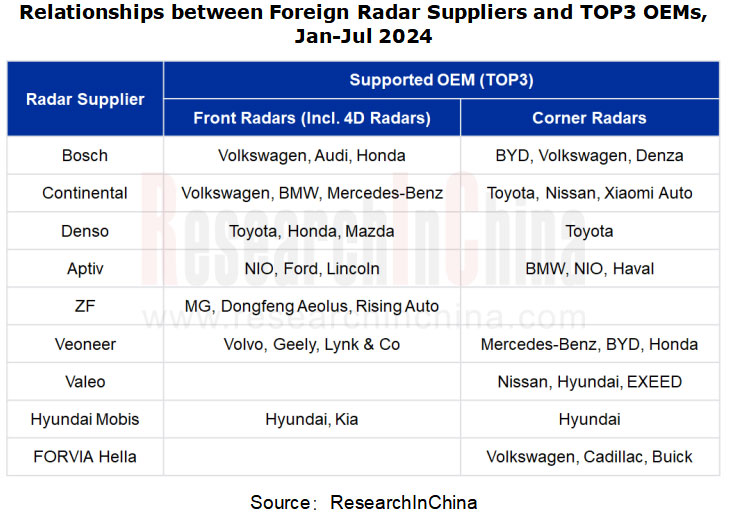
Bosch, Continental, and Denso are the top three front radar suppliers in China, with a combined market share of more than 70 per cent. But Chinese domestic suppliers are ramping up and gaining market share. The combined share of Bosch, Continental, and Denso has trended from 84.1 per cent in 2022 to 82.1 per cent in 2023, and 74.6 per cent from January to July 2024. Meanwhile, the share of Chinese suppliers such as Sensortech, Cheng Tech, and Huawei is expanding. From January to July 2024, their combined market share totalled 13.3 per cent.
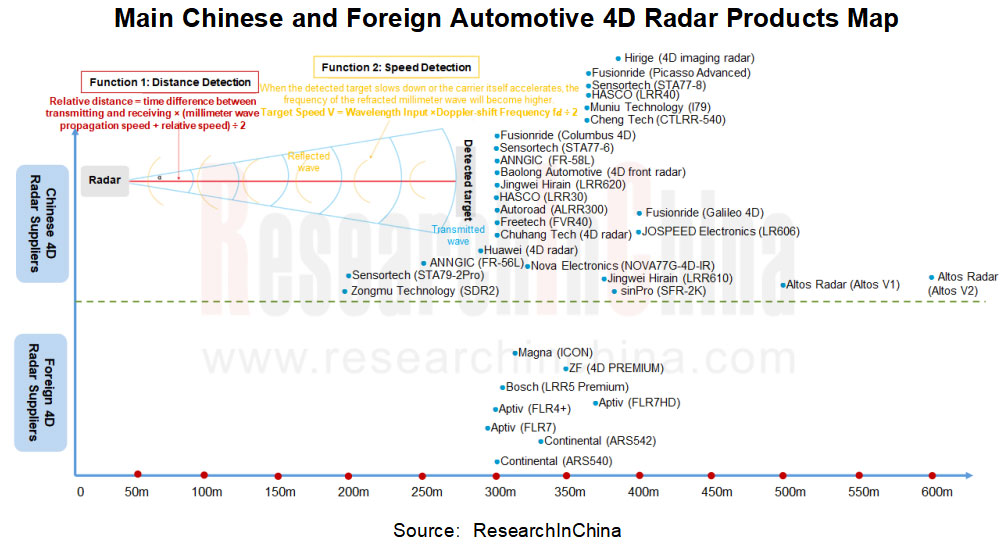
In the context of cost reduction and efficiency improvement and fierce competition, automakers are choosing suppliers on price. As technology advances and its mass production and application accelerate, Chinese radar suppliers are providing more front radars (including 4D radar) and corner radars (including 4D radar), scrambling for bigger market share.
For example, in October 2023, Sinpro completed the industry’s first fully automatic 4D imaging radar production line, expected to produce 800,000 units annually after operation. In August 2024, Sinpro’s self-developed automotive dual-chip 4D imaging radar SFR-2K entered mass production, supporting models such as Nio’s ET9 and the Onvo L60.
Chuhang Tech has a production base in Anqing City, with annual capacity of more than 1.8 million radars (including 4D radars); Cheng Tech’s total annual capacity of radars is up to over 13 million units (including 4D imaging radars).
Four development trends of radar technology
The upstream end of the automotive radar industry chain is still dominated by non-Chinese chip and module vendors; top names include Infineon, ADI, NXP, ST, TI, Renesas, Onsemi, Arbe, and Uhnder. Chinese radar suppliers are also developing rapidly, and quite a few startups have emerged; notable names include Calterah, Osemitech, and SenardMicro.
Antenna efficiency
In radar design, the first thing to consider is how to improve antenna efficiency. The industry is developing from microstrip antenna to waveguide antenna technology, which reduces energy loss; suppliers like Bosch and Continental use it. Air waveguide antennas have even lower capacity loss. Suppliers working to promote it include Aptiv (4D radar FLR4+), and XretinAl Technology; compared with microstrip antennas of the same size, their Quasi-Air Integrated Waveguide (AIW) antennas enable a gain boost of about 5 dB.
RF stages to antennas optimised coupling
Antenna packaging technology is evolving toward AiP (antenna in package), to reduce antenna feeder loss. A few companies such as Calterah have launched ROP (radiator-on-package) technology, which uses solder balls to connect RF signals, has higher channel isolation, and offers a longer detection range and a wider FOV.
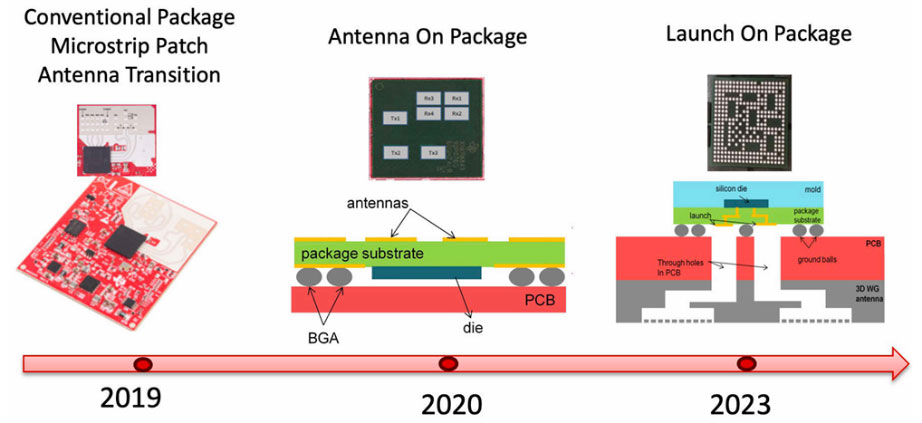
The more advanced LoP (launch on package) technology is being used by Continental in the production of their sixth-generation radar chips. LoP enables the electromagnetic waves emitted by the radar to propagate directly from the chip through the air waveguide, avoiding the higher energy loss and high cost caused by etching the antenna on the circuit board, achieving low cost and improving the radar’s detection performance.
Interference mitigation
Signal anti-interference is also a factor that must be considered. For example, one of the unique benefits of Uhnder’s single 4D digital imaging radar chip with 192 virtual channels (12T 8 × 2R) is the use of advanced digital code modulation (DCM) technology, which can effectively improve the anti-interference performance of the radar system and resist interference signals in various complex environments. To prevent multiple vehicle radars from transmitting RF signals at the same time in overlapping frequency bands, Continental uses an intelligent time synchronization approach to prevent interference between the vehicle radars. To avoid interference from radars on other vehicles when the vehicle is traveling, coding is added to the waveform and decoding is performed as the echo signal is received.
Satellite architecture helps create more cost-effective 4D radar products
In radar design, the most critical thing is that the signal processing architecture is developing towards satellite architecture. This distributed architecture can leave most of the signal processing and object recognition tasks to the central processing unit, thereby exploiting the computing power and computing resources of the central processing unit. The higher computing power and more software processing are a solution to stable detection and other problems of radars in the case of a complex scenario and multiple objects.
For example, the Altos RF Series is a non-computing front-end radar module, a radar solution deeply integrating domain controllers, with price about half of similar models with processors. It uses the computing resources of the intelligent driving domain controller or the central domain controller to generate high-quality point clouds.
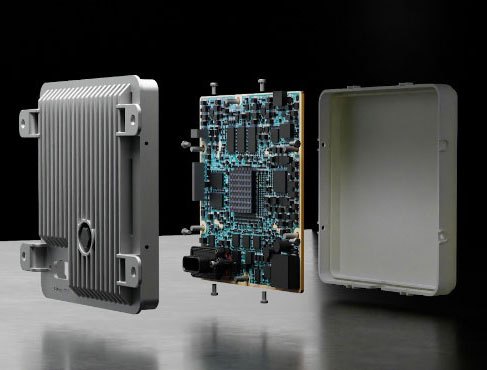
The Altos V2 shown here is the world’s first mass-produced 4-chip cascaded imaging radar based on TI’s TDA4. It boasts:
High angular resolution: 1.38° azimuth × 1.43° elevation (antenna array intrinsic)
Long detection range: cars @ 400m, pedestrians @ 200m
Precise velocity detection: no ambiguity in single frame from -400km/h to +200km/h
Dense point cloud: up to 6000 points per frame @ 15 fps
Extreme low noise: a fraction of that from competing products
Simple and robust: single PCB, 3 parts total.
Yet satellite radars also face challenges, including:
- Processing large amounts of data increases the hardware cost of domain controllers
- Mainstream high-power chips’ support and compatibility with radar algorithms needs to be improved and optimized
- OEMs now still mainly use the object-level data output by satellite radars and have technical difficulties in using ADC data directly. They are reluctant to switch between satellite radars and traditional radars, and more actual cases are needed to promote market acceptance.


