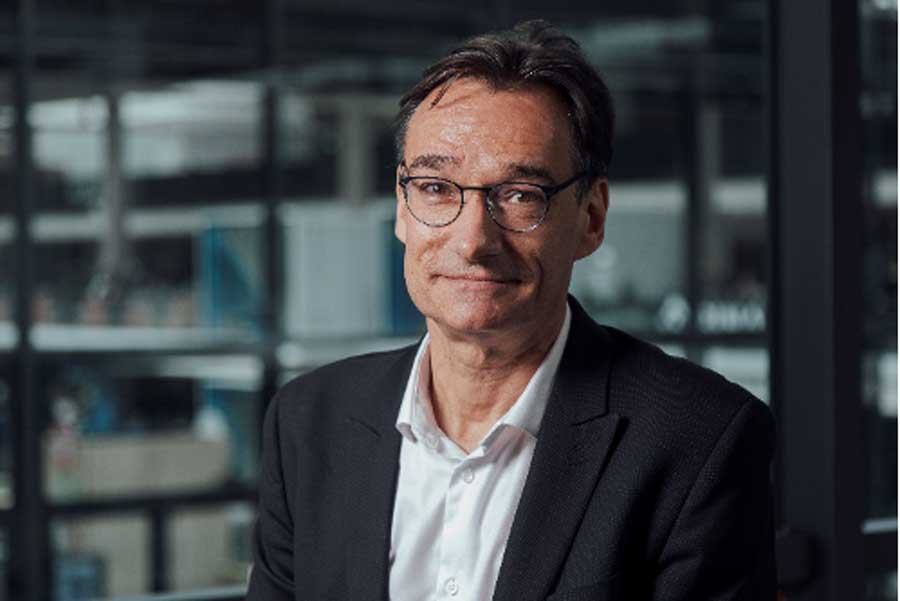
Dr François Simoens is the CEO and the co-founder of SteerLight, a deeptech start-up founded in July 2022 with the ambition to provide smarter 3D vision with a new generation of miniaturized FMCW silicon-photonics based LiDAR sensors. He built this disruptive value proposition on his prior involvement in photonics developments for more than 25 years. After involvements R&D for accelerator physics, he joined CEA-Leti in 2003 to contribute to R&D institutional and industrial project before taking the position of program manager and expert in the imaging sensor field. During the 15 last years, he has been acting as Business Developer for industrial partnerships and Marketing Manager for the strategic imaging domain.
DVN: Steerlight was founded in 2022, what is the history of Steerlight and why did you create a start-up?
François Simoens: Founded in 2022 as a spin-off of the French CEA-Leti technology center, the deeptech start-up SteerLight develops a new generation of 3D vision sensor that is an on-chip FMCW LiDAR. The ambition is to bring to the market this disruptive LiDAR solution that meets the requirements of mass volume applications, and in priority for mobility and Industry4.0 markets.
This innovation draws upon a strong portfolio of patents and know-how that CEA-Leti has been developing for more than 10 years, combining expertise in photonics, microelectronics, and embedded algorithms. In addition, after an in-depth market study by the two co-founders, thaye have launched in 2019 and managed a multidisciplinary internal CEA ‘LiDAR intégré’ program in order to design and to manufacture Lab Proofs of Concept to validate the proposed solution. This program has brought SteerLight first major milestones that were in particular recognized by the awarding of the i-Lab ‘grand’ prize, a major French national innovation competition.
DVN: Which applications do you plan for your product: Robotics, Automotive, …?
François Simoens: The core of the SteerLight innovation stands in silicon photonics technology that puts the system on a microchip and paves the way to cost-effective volume production. This non-mechanical system provides robustness and simultaneous depth and velocity data that are key features for mobile applications that SteerLight targets as first markets.
Our first objective is to address industrial markets, particularly for intralogistics and industry 4.0 applications. Typically, this first product will address the needs of the indoor robotics, AGVs and AMRs.
Then, a second generation with extended performance –such as the field of view and range- will serve customers in both the industry and the automotive sector, aiming for mass production at a competitive price.
DVN: Which product range do you target: Long Range & Short range Lidars?
François Simoens: Our first product will target the 50 m range that is sufficient for indoor industrial applications and possibly a few outdoor applications too. The long range version of our of Lidar will be targeted by the second generation of product.
DVN: Your Lidar is based on the FMCW technology, could you tell us more about your technology, and target specifications?
François Simoens: The core photonics chip of the LiDAR module integrates as a system in package –or SiP- the 3 functional blocks of FMCW LiDAR: a 1550n laser chip-on-carrier, Optical Phased Arrays –(OPAs) to shape and steer the laser beam electronically without moving parts and a heterodyne detection part. The FMCW feature enables the delivery of mixed signal that provides high sensitivity, Doppler velocity information and high immunity to sunlight and other LiDAR signals. The OPA and the heterodyne detection are integrated in a single Photonics Integrated Chip (PIC). The corresponding optical functions are driven by CMOS electronics ICs that were designed by SteerLight and CEA-Leti.
DVN: When will your first representative prototype be ready, when do you plan your first SOP?
François Simoens: Our next step is the release of functional demonstrator prototype by the end of Q4/2024. This module will demonstrate all the key functions of our 2D LiDAR provided by our SoC (System on Chip). In the meantime the SteerLight team designs the first product that specifications are given by the future customers. The manufacturing of the first prototype will be launched in 2025 with the target of the availability of a first product prototype ready for tests with customers by 2026. In the meantime the second generation of product will designed and first prototypes will be available for tests in 2027 before the qualification process.
DVN: How did you get your fundings, why did Stellantis invest in Steerlight?
François Simoens: In March 2024, SteerLight announced the closing of a €2 million funding round from a group of investors led by Stellantis Ventures, along with Quantonation and LIFTT, renowned major venture capitals in deep-tech investments. As published by SteerLight in our press-release, this funding comes on top of a €1.2 million loan granted by three banks, including Bpifrance.
As expressed in the Stellantis Press-release of March 2024, “Stellantis Ventures Invests in Breakthrough, Cost-effective LiDAR Technology for Advanced Driver Assistance Systems”. As explained by Ned Curic, Stellantis Chief Engineering & Technology Officer, “A central aspect of our Dare Forward 2030 initiatives is identifying groundbreaking technologies that deliver substantial value to our customers on a large scale. Automated driving enhancements remain a top priority at Stellantis. The game-changing work at SteerLight can enable enhanced and widespread ADAS applications.”
DVN: What is your business model : will you be Tier1 or Tier2, do you to use some facilities from the CEA?
François Simoens: With a B2B business model, the ambition of SteerLight is to serve a market of several millions units per year in the long run for a wide range of markets. Our ambition is to provide LiDAR modules as COTS for automotive and industry but also for smart cities, services, human assistance, etc… Our vision for Steerlight is to become the fabless supplier of standard modules that can benefit all integrators. Our business model in the automotive sector is under discussion and not yet arbitrated.
As part of our collaboration with the CEA, we have access to the Leti’s 10 000 m2 clean rooms and tests facilities for our R&D works to feed the future product roadmap. The manufacturing of the commercial prototypes and final products are all manufactured in industrial semiconductor foundries, either for CMOS and Silicon Photonics chips. We are convinced that the fabrication and the assembly of the on-chip LiDAR sensors with silicon photonic technologies is the only way to enable modularity and ultra-miniaturization thanks to its compatibility to standard semiconductor industry. , and to pave the way to volume manufacturing and the associated price scalability. One of the topics we are currently working on is the qualification of foundries for the future manufacturing of our ICs.
DVN: We see announcement related to high volume Long Range Lidars for L2+ applications in China with a cost below 200$, will you be competitive with these lidars?
François Simoens: The SteerLight solution combines OPA-based non-mechanical beam steering and 1550nm FMCW architecture with manufacturing with this universal material that is silicon. We are convinced this this combination of photonics and electronics in a compact system-in-package brings all the assets to succeed in this challenge.
DVN: How do you see the market in 5 years from now for long & short range lidars in EU, US, China?
François Simoens: It is risky to comment on such timeline in the turbulent geopolitical and economical context. But for sure we are convinced that the market will push for the development of LiDARs that meet constraints for a mass-market adoption that are the strict size, weight, power, and cost (SWAP-c). These are the key features of the SteerLight solution. This future generation of LiDARs will fulfil the needs of countless applications, the most notable of which is assisting in partial or full autonomous driving.
DVN: Are lidar and imaging radar competing or complementary? Do you think the radar/lidar performance and cost gaps will narrow?
François Simoens: Since optical wavelengths are smaller that radiofrequency by three orders of magnitude, LiDARs provide intrinsically 3D vision with unrivalled accuracy and resolution in combination to the key asset that their volume is also naturally more compact. With Silicon photonics technology that paves the way to cost reduction with volume, the quest of safe mobility will come with the need for enhanced 3D environment perception by FMCW LiDARs with complementary sensors. This trend includes radars to help in security level under bad weather conditions.


