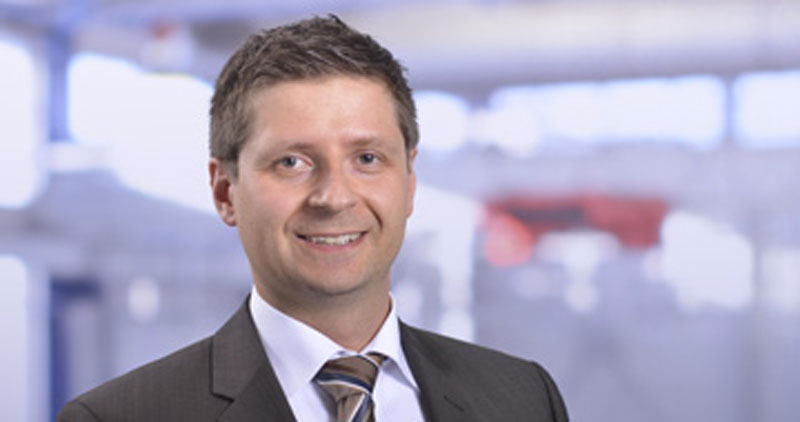
Adrian Zlocki has been in charge of automated driving activities at FKA since 2012. Before that, he headed the company’s coöperative AD activities with Rheinisch-Westfälische Technische Hochschule Aachen University, where he obtained his PhD in automotive engineering. His experience in the field goes back at least as far as 2004, and he enthusiastically shared his insights and thoughts with us.
DVN: FKA is an engineering and testing provider for ADAS and AD systems. What can you tell us about the company and your activities?
Adrian Zlocki: For more than 35 years, FKA has been an innovative engineering service provider for research and development tasks for the automotive industry and its suppliers. As a spinoff from the Institute for Automotive Engineering (IKA) at RWTH Aachen University, it was founded in 1981 by Professor Jürgen Helling. His most important goal was to act more independently from public research funds and continue working in an academic and scientific manner, putting more emphasis on an industry-oriented and practical approach with a focus on its key topics: efficiency, safety and driving pleasure.
FKA provides the full range of engineering services for its worldwide customers, which include conception and simulation, as well as design and engineering of prototypes, and their experimental testing. Flexibility, an adherence to schedules and the highest level of cost and quality awareness play an important role at the same time. The chassis, body, drivetrain, electrics-electronics, and automated driving departments collaborate closely with the cross-section strategy & consulting, acoustics, vehicle concepts, thermal management, and user experience & performance departments to achieve efficient and accident-free driving pleasure, by optimizing and cross-linking subsystems and vehicle components.
FKA puts the focus of its activities on pre-development and integration tasks for single components and complete systems, as well as holistic inspection of the vehicle with its multiple interplays. Moreover, FKA engages with the domains of training and specialization, offers courses for various research focuses, and is also the organizer of renowned conferences.
ADAS and automated driving is one of FKA’s core business units. Since the introduction of first ACC systems at the end of the 1990s, FKA is active in testing ADAS sensors and functions. FKA is involved in many public and private research projects with strong focus on testing and safety assessment and assurance methodology.
DVN: What are typical FKA research projects and customers?
A.Z.: Customers of FKA are the overall automotive industry. We work for OEMs and suppliers not only in Germany and Europe, but also in the USA and in Asia. FKA operates an office in California—FKA Silicon Valley—to work closely with the AD and tech companies there. Most of FKA’s work is on a bi-lateral basis with specific customers on specific research questions.
FKA is also partner—or linked third party with the Institute for Automotive Engineering of RWTH Aachen University—in various publicly-funded projects. Within these, FKA usually develops methodologies. Examples are the German funded PEGASUS project, in which FKA developed the first concepts for a scenario database for safety assurance of automated driving, and the current Hi-Drive project in which FKA will demonstrate cross-border automated driving and develops processes for harmonised road testing on a European level, and the Code of Practice for automated driving.
As for sensors, FKA undertakes projects with OEMs and tier-1s as well as lidar manufacturers to develop methodologies for testing. The goal is to provide customers with standardized testing procedures as well as offering the tools to test scenarios which are tailored to customers’ specific needs. FKA also tests sensors in physical tests on the proving ground.
DVN: Are you taking part in European or nationally-funded research projects as a significant part of your activity?
A.Z.:FKA’s lidar activities were initially developed within the PROMETHEUS project at the end of the 1990s, the first European-funded project on vehicle intelligence. For current lidar projects, external funding on a national or European level is not foreseen. Instead, the idea of collaboration between different partners is applied. Basically, FKA formed a group of industry partners to reach the project goal. In this group, every project partner contributes to the final results of the activity.
DVN: Last year, FKA created an industry consortium to develop the first DIN specification for lidar performance assessment, which was published this past April. Tell us about that, won’t you?
A.Z.: DIN SAE spec 91471 describes a basic assessment methodology for automotive lidar sensors for external environment sensing. It consists of common sensor specification and characterization guidelines and a common and application-relevant evaluation framework, which includes test scenarios, key performance indicators and evaluation tools. The spec is publicly available for free and can be applied by sensor manufacturers, car manufacturers, and test houses such as FKA. This specification is technology-agnostic, meaning it should work for any type of automotive lidar sensor on the market. Although the focus is on mid- and long-range lidars, the specification can be easily applied to short-range lidars as well. This requires a slight change in the parameters such as target sizes and distances to targets.

Extract of Test Set-ups

DVN: Creating standards is a priority to show lidar is a mature technology, so what are the next steps?
A.Z.: In DIN SAE spec 91471, the boundary conditions are ideal: no weather influences, no dirt or any other influences are foreseen in the test scenarios so far. This does not reflect automotive reality. In the next project, the goal is to focus on adverse conditions. The next project includes three adverse conditions: weather (rain, fog, snow); contamination (dust, dirt, road spray), and interference (lidar vs. lidar, lidar vs. light, etc.).
DVN: Are you aware of other activities like this in the world?
A.Z.:Certainly! lidar performance assessment is currently in focus of many activities. There is an ISO activity ongoing, ISO/PWI 13228. Hopefully the DIN SAE spec provides a good basis for all considerations on the ISO level. Adverse conditions are not part of the ISO activity, and therefore are complementary. Furthermore, the ISO timeline is different from FKA’s project.
On the SAE level there is also strong interest to focus on lidar assessment. We are aware of these activities and collaborate with SAE in order to not re-create what already exists.
There are also standardisation activities pertaining to lidar sensors that cover other aspects such as laser safety, functional safety, network security, and SOTIF. Our focus, however, remains on performance evaluation of lidars, although we do keep an eye on these activities as well.
In research, there are several projects on the EU level focusing on sensor performance assessment. We closely monitor the output of these projects and offer our expertise. We certainly are open to any discussions and want to share our experience and knowledge as far as possible.


