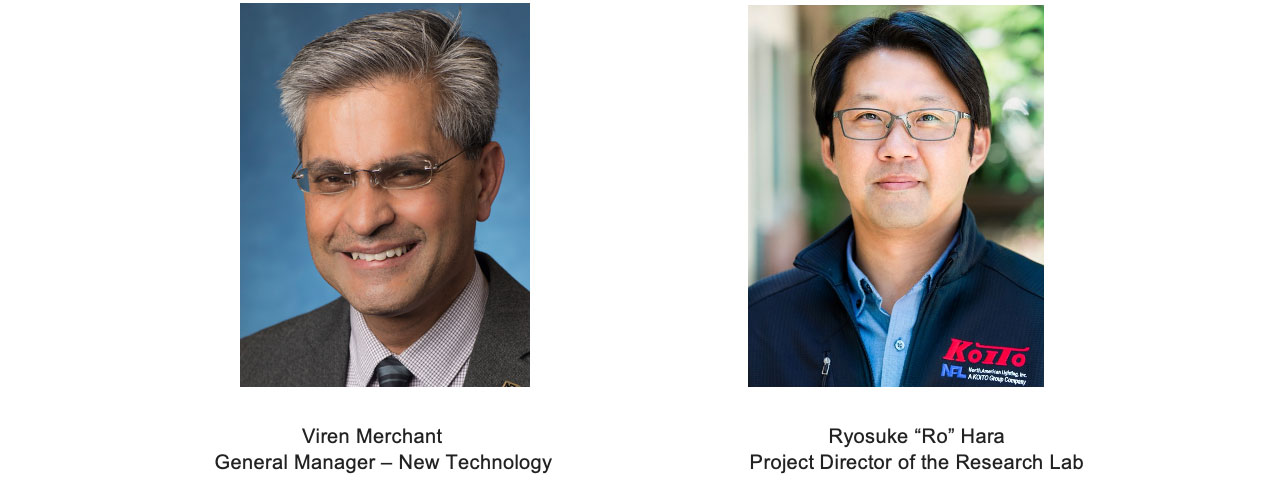
DVN had the opportunity to visit Koito’s laboratory in Sunnyvale, California—a centroid of Silicon Valley. We met with Viren Merchant, General Manager for New Technology and with Ryosuke “Ro” Hara, Project Director in charge of the Silicon Valley Lab.
DVN: Where does Koito stand in the lighting business, as a supplier?
Koito: Koito is a Japanese company, the worldwide leader for Headlamps (20-per-cent market share), with a revenue in 2022 of ¥864bn. The group company of Koito has also a significant activity in Japan for lighting systems related to infrastructure like streetlights, traffic lights, and traffic management systems.

DVN: What are the interest areas for Koito and NAL in Silicon Valley?
Koito: Our focus is the technology contributing to the future mobility society. In particular, we are investigating technologies related to sensing support and communication support. Regarding sensing technologies, it includes radar, lidar and cameras (visible, IR, thermal). Regarding communication, it includes V2X, Lighting and display technologies.
DVN: What does the relationship look like these days among Koito Japan, NAL, and Koito lab?
Koito: NAL is a subsidiary of Koito (Japan) and has a lab in the Silicon Valley that researches new technologies.
DVN: What’s your approach to startup companies?
Koito: Since 2017 we have aimed to collaborate with startups, including a joint development with Cepton and have done some demonstrations at CES.
DVN: Koito has done several presentations at DVN-Lidar workshops about lidar integration in the headlamp. What’s the state of that thinking?
Koito: Automakers and ADAS system suppliers would like to expand the ODD (operational driving domain) using multiple sensing technologies. This will increase the variety of sensors, including lidar, and we assume that mounting locations will become an issue. The integration into lighting systems can be one of the solutions. Also, by integrating sensors with lamps, the risk to spoil the vehicle design can be minimized, and the lamp cleaner can be used to remove dirt. Koito has been doing cleaning systems since the 1970s and has demonstrated a few concepts. The headlight already has cleaning, and the real-estate is already there.

DVN: What can you tell us about Koito’s Cepton investment?
Koito: Koito has invested $200m in Cepton so far. Joint development started in 2018, and we are currently providing development support for the market launch and mass production. For mass production Koito is responsible for the final assembly and system validation including functional safety. Koito is the Tier1 dealing with the customer. Tier-1s play a big role in alignment and calibration; many of the smaller lidar players do not have experience doing this.
DVN: Which applications are the most suitable for sensor integration in lamps?
Koito: Our focus is not only passenger cars, but also trucks and robotaxis. Right now, truck and robotaxis are further along for autonomous drive, and are more flexible for sensing integration in lamps.
DVN: What are the challenges faced when putting lidar components into lamps?
Koito: Mounting into the lamps is attractive from a real-estate perspective, but the headlight design is different for each vehicle, so the lidar design has to be optimized for each vehicle. Heat is also a challenge for integration. Alignment for lidar is also more of a challenge than with headlights.
DVN: Do you stick to one technology in your lidar developments?
Koito: We are looking at FMCW and Flash technologies for the future.
DVN: How do you see lidar technology compared to the other sensing technologies?
Koito: Koito has been working on advanced vision systems e.g. with Bright Way Vision on gated camera systems in bad weather. Lidar is competitive with gated cameras. Nevertheless, we see a need for redundancy between the different sensing technologies to achieve robust applications for autonomous vehicles. We are also looking at sensor fusion technology between lidar, cameras, and other sensors.


