The AutoSens event, held in Detroit on 9 to 11 May, was a good occasion to get an update regarding the limitations of the different sensing technologies to expand the ODD—the operational design domain—which is the next challenge to support a large deployment of AVs.
RGB Cameras: Nodar did a presentation on their technology’s ability to significantly enhance RGB cameras’ performance in nighttime conditions. Ubicept, too, explained their real-time fast motion optical imagery across challenging environments.
IR cameras: There was broad consensus at the event taht IR will dratatically improve pedestrian detection, and that at scale, a ~$100 thermal camera will be a reality. However, regulation demanding pedestrian-AEB in bad conditions would be necessary, since buyers won’t pay for safety of those outside their own vehicle. It was noted that huge volumes of smartphone sales have driven down the cost of RGB camera technology, but there is no equivalent in sight for IR.
Lidar: the expansion of ODD is a clear driver of lidar penetration. Aeva laid out the many benefits of FMCW lidar, which clearly has future. Valeo spoke of the 12.3 megapoints-per-second performance of their Scala3 lidar in two versions: Smart Bumper, and Satellite Slim. Cepton showed their lidar’s small height and volume—0.63 litre—which allows packaging behind the windshield and an easy cleaning with the wipers.
Radar: Arbe described the many benefits of 4D imaging radar, a technology working in all weather and light conditions. Due to its large number of channels—2,304 of them—imaging radar allows high 3D separation capabilities and tracking, while providing clustering and boundary boxes like a camera.
Lidar Market: Woodside Capital Partners shared their view of apposite M&A and investment activity: the depressed market conditions are expected to continue at least through the end of 2023. The SPAC lidar rush of 2021 is well past, and consolidation is taking place. 2023 is expected to be a breakthrough year for lidar design wins, as applications proceed for future production vehicles.
Market trends
- Safety regulations will drive ADAS adoption with L2 vehicles to almost 50 per cent in 2022;
- Low M&A levels are expected at least through the end of 2023;
- Sensor fusion continues to be a major objective while 2D and 3D cameras with 4D radar will dominate the market in the short term;
- L3 vehicles will not be produced in significant numbers until 2030, and
- Automotive software will be the dominant focus over the next five to 10 years.
DVN comment
Fusion of 4D imaging radars and 2/3D cameras: the recent partnership between Uhnder (imaging radar technologies), and South Korean Bitsensing (radar solution provider) to develop 4D digital imaging radar solutions for Korean automakers, shows the technology is maturing.
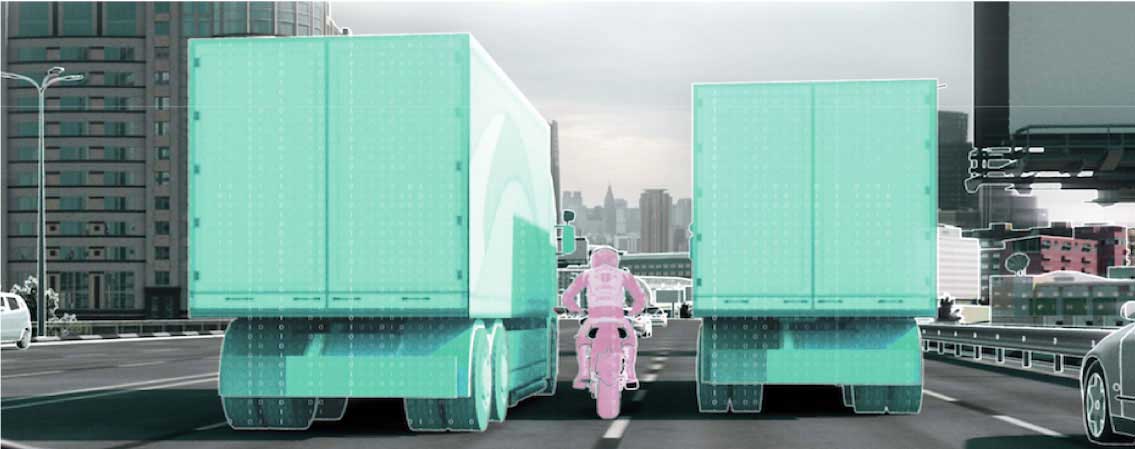
The solution will enable advanced safety features, such as automatic emergency braking (up to 300-metre range for pedestrian detection); adaptive cruise control; and lane departure warning, while also enhancing object detection and tracking capabilities even in heavy rain; snow; fog, and bright sun. In addition, it can provide the best low-level fusion between radar and camera, which enhances the reliability of its performance across various conditions.
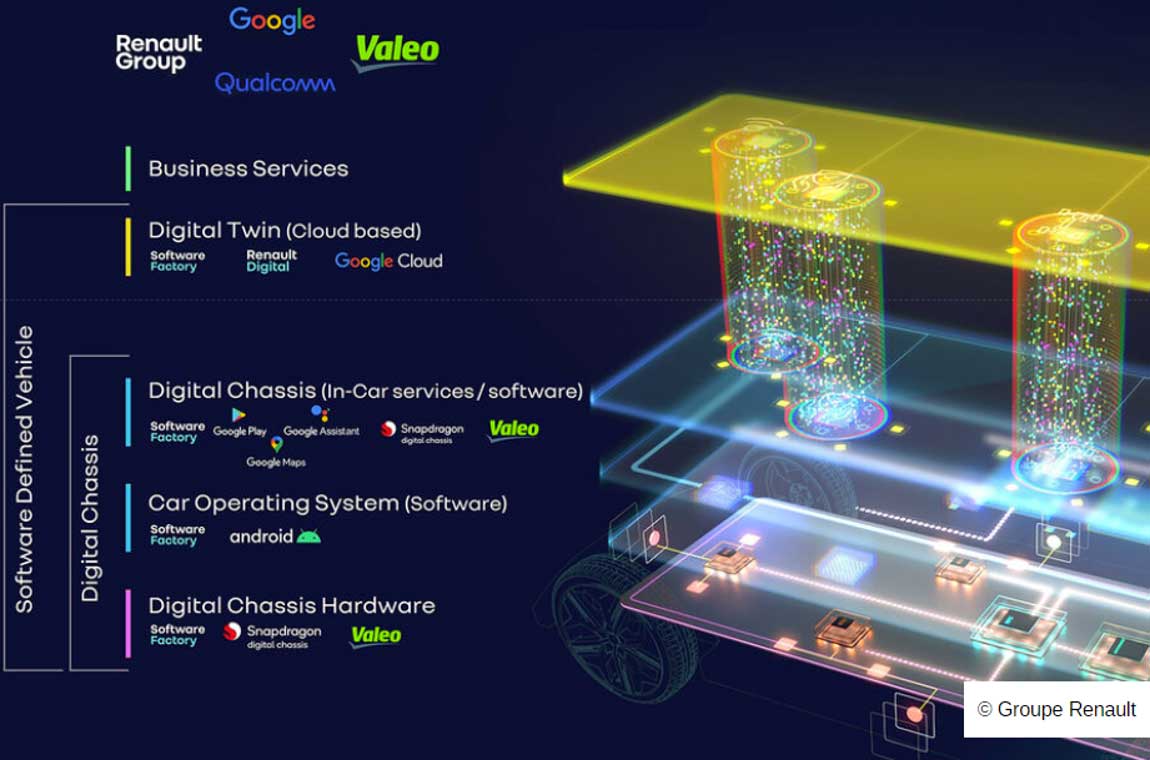
Software defined vehicles: a recent partnership announced between Valeo and Renault provides an example of software structure for digital chassis and powertrain management.