By Daniel Stern • DVN Chief Editor
First in a series
11 days ago, the US National Highway Transportation Safety Administration published a notice of proposed rulemaking to allow ADB in the world’s largest developed market not yet allowing the technology. And six days ago, the SAE Lighting Systems Group ADB Task Force held their first meeting about it. With local participants in Michigan as well as remote participation by WebEx and phone from interested persons located across North America and parts of Europe, the meeting lasted over an hour and a half—and the plan is for meetings like this to convene on a weekly basis for the foreseeable future. Unless someone applies for an extension and NHTSA grants it, that future is just 49 days long; the public comment period on the proposal closes on 11 December. Right from go, there are mixed feelings about this state of affairs; on one hand, it can legitimately be said that a rule allowing ADB—any rule allowing any ADB—will be an improvement over the present total ban. On the other hand, there’s that sinking-pit-of-stomach feeling of being stuck between bad and worse: it is felt that many points and provisions in NHTSA’s proposal warrant a great deal more thought and care, and that it will take a great deal of time to run tests and experiments to generate the data needed to persuade NHTSA to make adjustments. The timing is difficult, too: if an extension is granted, a big chunk of the extra time will be unusable, as it would coincide with Christmas and New Year’s when it’s difficult to get any work done.
So what are the issues? Too many to cover in one article, so for this first look we’ll cover some of the bigger ones, with others analysed in future instalments of this series.
What is ADB?
First off, what is ADB? Fundamentally, what kind of beam is it? The name of the system offers a clue; “driving beam” is the UN and European term for what Americans call a “high beam” or an “upper beam”. And the way the system works offers a further push in that direction; it’s a system that selectively shadows other road users out of a high beam light distribution, hence its alternative name, “glare-free high beam”. So in those functional and nominal senses, ADB is a special kind of high beam. Then again, ADB also has the core glare-control functional element of a passing beam (low beam, lower beam, dipped beam), which is defined as the beam “to illuminate the road ahead of the vehicle without causing undue dazzle or discomfort to oncoming drivers and other road-users” (UN R48) or “to illuminate the road and its environs ahead of the vehicle when meeting or closely following another vehicle” (US FMVSS 108). So, which kind of beam is ADB? Really, it is a whole new kind of beam that doesn’t squarely fit into either of the traditional headlight beam types. That’s the whole point of the system, which allows much finer-grained reconciliation of the simultaneous needs for more seeing with less glare (or at least without more glare). Ideally, ADB provides high-beam seeing with low-beam glare.
The NHTSA proposal, though, is based on categorising ADB as a kind of low beam. It would require (S9.4.1.6.6) that ADB systems meet all low-beam minimum intensity requirements at all the low-beam test points, even when the ADB glare-blocking shadow coincides with a low-beam test point. That would seem to kick one leg out from under ADB’s ability to do its more-seeing/less-glare job effectively.
Tomorrow’s Headlamps, Yesterday’s Photometrics?
Of probably even greater concern is that the proposal seems to kick the other leg out from under ADB, by requiring that ADB systems meet all high-beam maximum intensity requirements at all the high-beam test points—including the 75,000-candela axial maximum. The consistent reasons NHTSA has given over the years for not raising the maximum high beam intensity above 75,000 candela are:
• Risk of glare caused by misuse of high beams, especially for older drivers who are more sensitive to glare,
• Higher-intensity high beams would require states to change their laws regarding when drivers have to switch to low beam for oncoming or preceding cars, which NHTSA can’t force states to do, and
• No seeing advantage to high beams more intense than 75,000 cd, the maximum intensity that can be properly and usefully controlled in a high beam (which NHTSA determined by research in 1977-’78 using small rectangular sealed beams).
Is it appropriate to cap ADB at an intensity limit left over from the sealed-beam era? Doing so would seem to throw away much of the safety performance benefit potential of ADB. Even before ADB was a plausible technology, thoughtful analytical research published in 2000 weighed in favour of raising the maximum (and minimum) allowable high beam intensities in the US headlamp standard. That research came too late to sway NHTSA’s opinion on the matter the last time they were asked to reconsider it; four years earlier, the agency had dismissed and denied a petition to raise the high beam intensity limit, saying the 75-kcd limit merely means headlamps “may not be as intense as some manufacturers might think that their customers might desire”.
Do NHTSA’s arguments in favour of the 75-kcd limit hold water in context of ADB? It seems they do not. ADB automatically and dynamically keeps glare out of other drivers’ eyes, which would seem to categorically address the worry about high beam glare. And that research analysis in 2000 thoroughly treated the issue of dimming distances prescribed in state laws, finding that the appropriate distance varies quite a lot situationally, and drivers tend to get it more or less right.
It is interesting to note that the UN Regulations permit high beam intensity of up to 112,500 candela per standard headlamp, but up to 215,000 candela per ADB lamp. Why might the intensity cap be almost double with ADB? Likely because ADB reduces—ideally, eliminates—the risk of glare-related problems caused by misuse of high beam instead of low beam in traffic.
As to the central point of whether drivers can see better with more-intense high beams: that’s a fair question to raise, since the inverse-square law means it takes a relatively large increase in intensity to get a relatively small improvement in seeing distance:
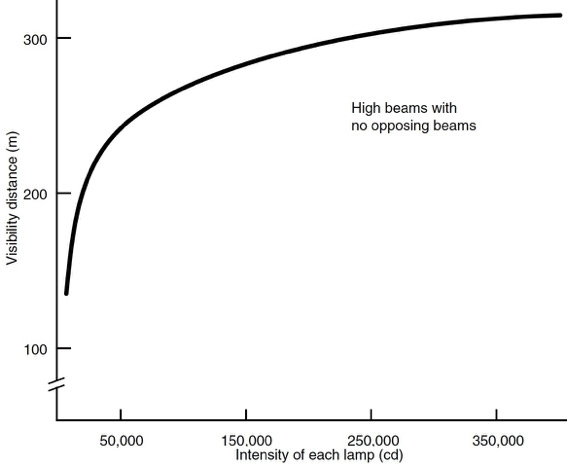
Nevertheless, there’s plenty of “meat” on that curve for a real, usable increase in seeing distance with increased intensity above 75 kcd per lamp—and given the size of the tasks before us on the road to Vision Zero, notably the grievously high number of pedestrian deaths on roads at night, it seems ADB’s removal of the glare danger makes high-intensity high beams into low-hanging fruit.
Testing, Testing; Check 1-2-3…1280!
NHTSA’s proposal calls for actual, real vehicles to be used in the certification tests of an ADB system, rather than lamp-rack mockups as specified in SAE J3069. Straightaway this weighs against repeatability of tests, which is supposed to be a core tenet of the American requirement for vehicle regulations to contain provisions that are objective, ajudged by tests that are repeatable. The proposal specifies that these should be any model of vehicle—car, truck, van, motorcycle—made within five model years of the system being certification-tested. Now, here is a big can of worms. What does that word “any” mean? Does it mean a system is acceptable that behaves correctly when tested against any stimulus vehicle chosen for the test? That’s not specified, but probably not; it more likely means trouble if the automaker tests with vehicles A, B, C, D, and E and the system passes, but NHTSA then tests the system with vehicles F, G, H, J, and K and it fails. Or what if NHTSA tests the system with the same vehicles A, B, C, D, and E that the automaker used, but headlamp aim variance means those vehicles look different to the ADB system on one test than on another?
Whatever the answers to those questions might be, the SAE ADB task force calculated that based on the requirements in the proposal, an enormous, impractical number of tests would be required: no fewer than 1,280 tests per system per stimulus vehicle. Two stimulus vehicles: 2,560 tests. Five stimulus vehicles: 6,400 tests. How many different stimulus vehicles would be needed to guarantee against NHTSA (or some other party, perhaps in preparation for a product-liability lawsuit) finding another vehicle, a kind not chosen as a stimulus vehicle in the certification tests, against which the system fails? If there’s a concrete answer to that question, it’s probably not one, two, or five. How about 20 different stimulus vehicles (25,600 tests)?
Furthermore, the proposal stipulates (S14.9.3.12.7.2) For tests conducted on curves with ambient light sources such as (…) infrastructure lighting that cannot be eliminated, the photometers will be zeroed in the direction of maximum ambient light. Doesn’t this open the door for tests to be strategically conducted in a location with bright street, stadium, billboard, or building lights that can’t be turned off?
But Wait, There’s More…!
First in a series
11 days ago, the US National Highway Transportation Safety Administration published a notice of proposed rulemaking to allow ADB in the world’s largest developed market not yet allowing the technology. And six days ago, the SAE Lighting Systems Group ADB Task Force held their first meeting about it. With local participants in Michigan as well as remote participation by WebEx and phone from interested persons located across North America and parts of Europe, the meeting lasted over an hour and a half—and the plan is for meetings like this to convene on a weekly basis for the foreseeable future. Unless someone applies for an extension and NHTSA grants it, that future is just 49 days long; the public comment period on the proposal closes on 11 December. Right from go, there are mixed feelings about this state of affairs; on one hand, it can legitimately be said that a rule allowing ADB—any rule allowing any ADB—will be an improvement over the present total ban. On the other hand, there’s that sinking-pit-of-stomach feeling of being stuck between bad and worse: it is felt that many points and provisions in NHTSA’s proposal warrant a great deal more thought and care, and that it will take a great deal of time to run tests and experiments to generate the data needed to persuade NHTSA to make adjustments. The timing is difficult, too: if an extension is granted, a big chunk of the extra time will be unusable, as it would coincide with Christmas and New Year’s when it’s difficult to get any work done.
So what are the issues? Too many to cover in one article, so for this first look we’ll cover some of the bigger ones, with others analysed in future instalments of this series.
What is ADB?
First off, what is ADB? Fundamentally, what kind of beam is it? The name of the system offers a clue; “driving beam” is the UN and European term for what Americans call a “high beam” or an “upper beam”. And the way the system works offers a further push in that direction; it’s a system that selectively shadows other road users out of a high beam light distribution, hence its alternative name, “glare-free high beam”. So in those functional and nominal senses, ADB is a special kind of high beam. Then again, ADB also has the core glare-control functional element of a passing beam (low beam, lower beam, dipped beam), which is defined as the beam “to illuminate the road ahead of the vehicle without causing undue dazzle or discomfort to oncoming drivers and other road-users” (UN R48) or “to illuminate the road and its environs ahead of the vehicle when meeting or closely following another vehicle” (US FMVSS 108). So, which kind of beam is ADB? Really, it is a whole new kind of beam that doesn’t squarely fit into either of the traditional headlight beam types. That’s the whole point of the system, which allows much finer-grained reconciliation of the simultaneous needs for more seeing with less glare (or at least without more glare). Ideally, ADB provides high-beam seeing with low-beam glare.
The NHTSA proposal, though, is based on categorising ADB as a kind of low beam. It would require (S9.4.1.6.6) that ADB systems meet all low-beam minimum intensity requirements at all the low-beam test points, even when the ADB glare-blocking shadow coincides with a low-beam test point. That would seem to kick one leg out from under ADB’s ability to do its more-seeing/less-glare job effectively.
Tomorrow’s Headlamps, Yesterday’s Photometrics?
Of probably even greater concern is that the proposal seems to kick the other leg out from under ADB, by requiring that ADB systems meet all high-beam maximum intensity requirements at all the high-beam test points—including the 75,000-candela axial maximum. The consistent reasons NHTSA has given over the years for not raising the maximum high beam intensity above 75,000 candela are:
• Risk of glare caused by misuse of high beams, especially for older drivers who are more sensitive to glare,
• Higher-intensity high beams would require states to change their laws regarding when drivers have to switch to low beam for oncoming or preceding cars, which NHTSA can’t force states to do, and
• No seeing advantage to high beams more intense than 75,000 cd, the maximum intensity that can be properly and usefully controlled in a high beam (which NHTSA determined by research in 1977-’78 using small rectangular sealed beams).
Is it appropriate to cap ADB at an intensity limit left over from the sealed-beam era? Doing so would seem to throw away much of the safety performance benefit potential of ADB. Even before ADB was a plausible technology, thoughtful analytical research published in 2000 weighed in favour of raising the maximum (and minimum) allowable high beam intensities in the US headlamp standard. That research came too late to sway NHTSA’s opinion on the matter the last time they were asked to reconsider it; four years earlier, the agency had dismissed and denied a petition to raise the high beam intensity limit, saying the 75-kcd limit merely means headlamps “may not be as intense as some manufacturers might think that their customers might desire”.
Do NHTSA’s arguments in favour of the 75-kcd limit hold water in context of ADB? It seems they do not. ADB automatically and dynamically keeps glare out of other drivers’ eyes, which would seem to categorically address the worry about high beam glare. And that research analysis in 2000 thoroughly treated the issue of dimming distances prescribed in state laws, finding that the appropriate distance varies quite a lot situationally, and drivers tend to get it more or less right.
It is interesting to note that the UN Regulations permit high beam intensity of up to 112,500 candela per standard headlamp, but up to 215,000 candela per ADB lamp. Why might the intensity cap be almost double with ADB? Likely because ADB reduces—ideally, eliminates—the risk of glare-related problems caused by misuse of high beam instead of low beam in traffic.
As to the central point of whether drivers can see better with more-intense high beams: that’s a fair question to raise, since the inverse-square law means it takes a relatively large increase in intensity to get a relatively small improvement in seeing distance:
Nevertheless, there’s plenty of “meat” on that curve for a real, usable increase in seeing distance with increased intensity above 75 kcd per lamp—and given the size of the tasks before us on the road to Vision Zero, notably the grievously high number of pedestrian deaths on roads at night, it seems ADB’s removal of the glare danger makes high-intensity high beams into low-hanging fruit.
Testing, Testing; Check 1-2-3…1280!
NHTSA’s proposal calls for actual, real vehicles to be used in the certification tests of an ADB system, rather than lamp-rack mockups as specified in SAE J3069. Straightaway this weighs against repeatability of tests, which is supposed to be a core tenet of the American requirement for vehicle regulations to contain provisions that are objective, ajudged by tests that are repeatable. The proposal specifies that these should be any model of vehicle—car, truck, van, motorcycle—made within five model years of the system being certification-tested. Now, here is a big can of worms. What does that word “any” mean? Does it mean a system is acceptable that behaves correctly when tested against any stimulus vehicle chosen for the test? That’s not specified, but probably not; it more likely means trouble if the automaker tests with vehicles A, B, C, D, and E and the system passes, but NHTSA then tests the system with vehicles F, G, H, J, and K and it fails. Or what if NHTSA tests the system with the same vehicles A, B, C, D, and E that the automaker used, but headlamp aim variance means those vehicles look different to the ADB system on one test than on another?
Whatever the answers to those questions might be, the SAE ADB task force calculated that based on the requirements in the proposal, an enormous, impractical number of tests would be required: no fewer than 1,280 tests per system per stimulus vehicle. Two stimulus vehicles: 2,560 tests. Five stimulus vehicles: 6,400 tests. How many different stimulus vehicles would be needed to guarantee against NHTSA (or some other party, perhaps in preparation for a product-liability lawsuit) finding another vehicle, a kind not chosen as a stimulus vehicle in the certification tests, against which the system fails? If there’s a concrete answer to that question, it’s probably not one, two, or five. How about 20 different stimulus vehicles (25,600 tests)?
Furthermore, the proposal stipulates (S14.9.3.12.7.2) For tests conducted on curves with ambient light sources such as (…) infrastructure lighting that cannot be eliminated, the photometers will be zeroed in the direction of maximum ambient light. Doesn’t this open the door for tests to be strategically conducted in a location with bright street, stadium, billboard, or building lights that can’t be turned off?
But Wait, There’s More…!
There are other issues of concern in the NHTSA proposal, but these are a start. The SAE ADB Task Force will be holding regular weekly meetings, at least some of which with provisions for remote participants, to identify and prioritise the issues, formulate an action plan for how to react, and collaboratively write a response to NHTSA. Watch for ongoing in-depth coverage here in DVN.


