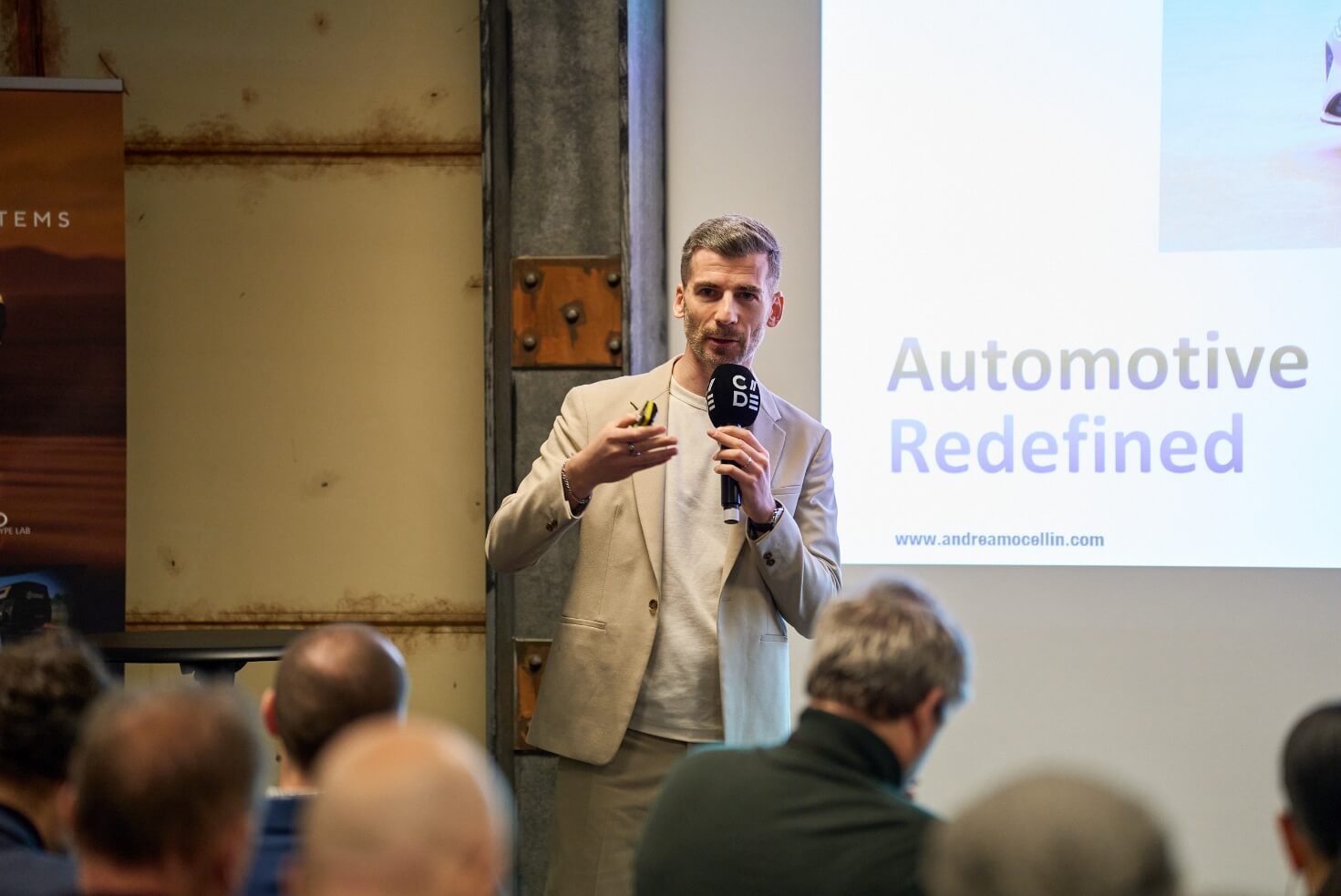
I had the chance to meet Andrea Moccellin during Car Design Event in Munich last March and exchange about the different needs for automotive lighting, automotive interior air aircraft cabins’. It is not every day I meet a design who joined both world and can talk about the common things, the different things, and then give us perspectives.
Paul-Henri Matha, DVN: Hi, Andrea, can you introduce yourself to DVN readers?
Andrea Mocellin: I’m an independent mobility designer working across aviation, automotive, and new mobility sectors. My background is rooted in transportation design, and I graduated from the Royal College of Art in London.
Throughout my career I’ve had the opportunity to work with some incredible brands and projects. I started at Pininfarina working on Ferrari programs, later joining Alfa Romeo and Maserati as a Senior Exterior Designer. I then became Chief Designer at Granstudio, contributing to both concept and production vehicles.
One of the most exciting chapters of my career was leading the design of the Lilium Jet, an electric vertical take-off and landing aircraft. That experience really opened the door to designing beyond traditional automotive boundaries.
Today I work as an independent designer on projects ranging from aircraft interiors to hypercars, micromobility and advanced mobility concepts. What connects all of these projects is the idea of creating meaningful experiences through design and lighting plays a surprisingly central role in that.
DVN: What is the difference between working for an automotive OEM, an eVTOL company, and an aircraft company?
A.M.: The differences are quite significant, mainly because the ecosystem around the product is very different.
In traditional automotive OEMs, design exists within a very structured industrial environment. Many decisions are influenced by platform sharing, product strategy, brand positioning, and internal alignment. Design becomes a way to synthesize many strategic factors that go beyond pure aesthetics.
Working with an eVTOL company is very different. Most of these companies operate more like startups. Product development is closely tied to technological breakthroughs, certification milestones, and investor confidence. Because the market is still emerging, the process is far more dynamic and reactive. Teams are usually very international, highly multidisciplinary, and the design process often evolves together with technology.
When working with aircraft companies or airlines, the mindset shifts again. The lifecycle of an aircraft is dramatically longer than a car, and the scale of usage is enormous, millions of passengers will interact with the same cabin over many years. That means design decisions must consider durability, maintenance, and long-term brand strategy in a much deeper way.
So, each sector has its own rhythm, its own constraints, and its own culture.
DVN: What is similar in lighting design between these three worlds? And what is different?
A.M.: Even though the industries are very different, the fundamental goal of lighting design is actually the same: creating a meaningful and comfortable experience for the user.
Today we see a growing awareness of wellbeing, comfort, and emotional experience in mobility. Lighting plays a crucial role in shaping that atmosphere. When the cabin or interior environment is relatively dark, whether in a car, aircraft cabin, or cockpit, light becomes the element that defines spatial perception.
Interior lighting helps passengers feel safe, oriented, and relaxed. It highlights important functional areas while also creating a calm ambient environment. Good lighting should never feel overly technological or aggressive, especially in real products. It should feel warm, intuitive, and almost invisible in how naturally it supports the experience.
On the exterior, the role of lighting becomes more about identity. In automotive design, lighting signatures have become a key part of brand recognition. In aviation the situation is different, because exterior lighting is largely driven by regulation and visibility requirements. Navigation lights and safety lighting dominate.
However, even there we begin to see small opportunities for design expression, especially as new mobility aircraft and eVTOL vehicles emerge.
DVN: Do you take inspiration from one world to another?
A.M.: Absolutely. I believe that innovation often happens at the intersection between industries.
Automotive lighting has developed extremely sophisticated brand signatures, which strongly influence the visual identity of a vehicle. This thinking is now also appearing in emerging aviation sectors like eVTOL, where companies want to communicate their brand personality through design.
At the same time, aviation brings lessons in durability, reliability, certification, and long-term operation that automotive can learn from, especially as vehicles become more complex and software-driven.
So, the exchange works both ways. Technology, design philosophies, and user expectations are increasingly influencing each other.
But of course, the final execution must always respect the context. Designing lighting for a car, an aircraft, or an eVTOL means designing for very different environments, constraints, and user behaviours.
DVN: What are the main trends in aircraft interior lighting design?
A.M.: Aircraft interior lighting has evolved tremendously in recent years, especially in premium cabins.
One of the most interesting developments is what I often call ‘light showers’: lighting systems that gently wash surfaces with light rather than focusing on individual point sources. These create a very soft, atmospheric environment that can transform the entire perception of the cabin.
Airlines increasingly treat the cabin like a hospitality environment, almost like entering a hotel lounge or lobby. Lighting becomes part of the welcome experience when passengers board the aircraft, guiding them through the aisle and defining different spatial zones.
Another interesting direction is the possibility to integrate subtle patterns or brand signatures into the lighting environment. This allows airlines to create a distinctive identity even within highly constrained cabin architectures.
Ultimately, the goal is to create a more human-centered environment, where lighting adapts to mood, time of day, and passenger needs.
DVN: What could automotive learn from aircraft lighting design?
A.M.: In many ways, aircraft, particularly long-haul first and business class cabins, are already exploring the future of interior experience.
Each passenger seat becomes almost a private micro-environment where people sleep, work, relax, eat, and watch media. Lighting is essential in shaping this experience because it highlights key functions while also creating a calm personal atmosphere.
Automotive interiors are beginning to move in this direction, especially as autonomous driving develops and vehicles become more passenger-centric rather than driver-centric.
As cars evolve into living spaces, lighting will play a larger role in defining comfort, spatial perception, and emotional quality. In that sense, automotive design could take inspiration from the sophistication already present in premium aircraft cabins.
There is a lot of potential to translate that level of atmospheric design!


