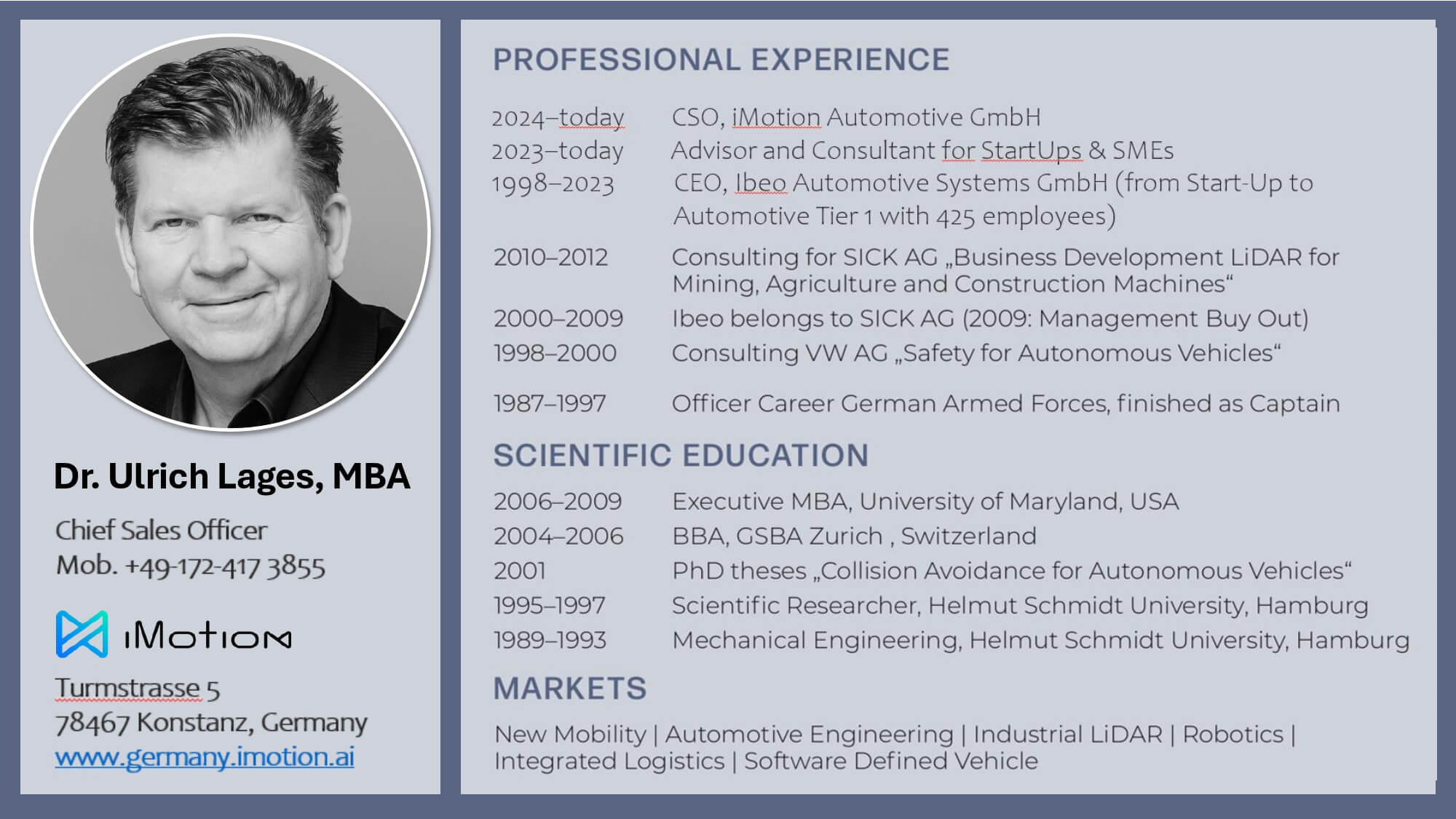
Ulrich Lages is iMotion’s Chief Sales Officer. He kindly talked with us about his company’s history and innovations:
DVN: Hi, there! Tell us about iMotion, will you please?
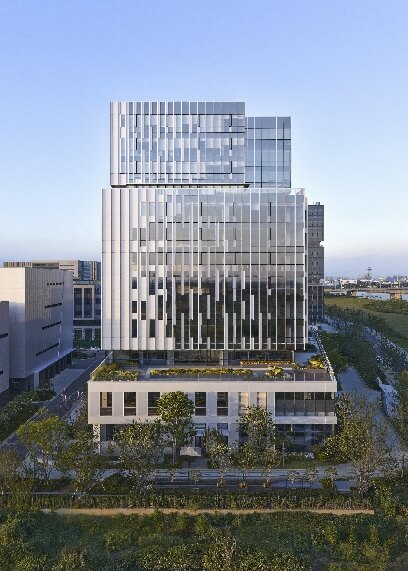
Ulrich Lages: iMotion was founded at the end of 2016; it is actually a 9-year-old company. We are operating in a scale of 600 associates, and our headquarters is located in Suzhou, China, with branches in 4 megacities in China – Shanghai, Beijing, Wuhan, and Guangzhou. In the past years, we’ve continuously expanded our footprint outside China, setting up an R&D center in Munich and a plant in Maylasia. Our products cover software and hardware, driving and parking features, with the further integration of E/E architecture, we do see the trend of cockpit and ADAS on one, therefore we are deeply looking into this area.
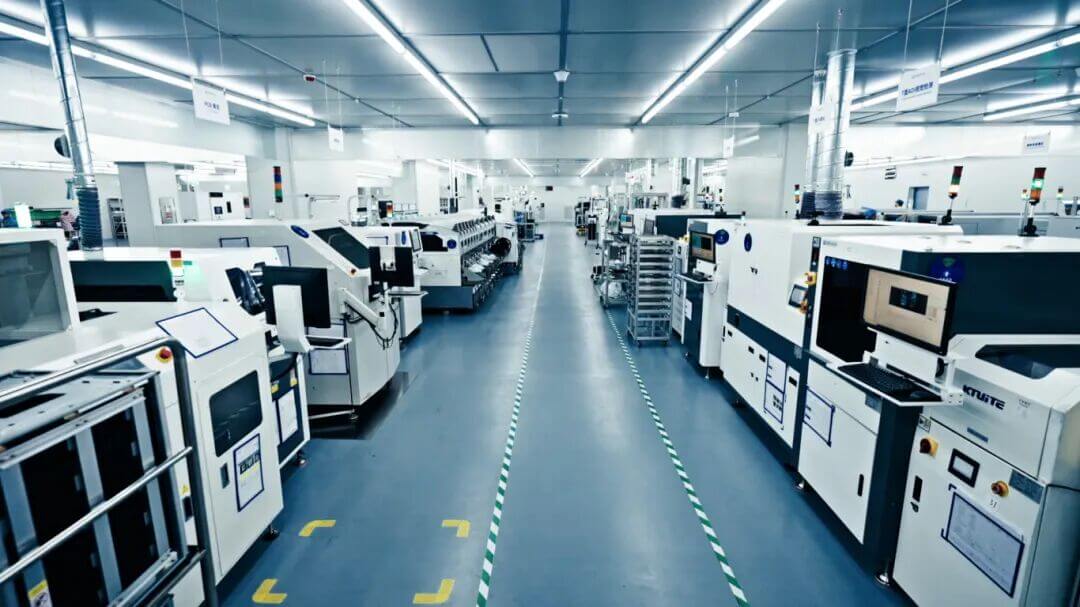
We have our own manufacturing facility including advanced SMT and automatic assembly lines, with sufficient capacity to support our customers. Currently we are serving 20 different customer groups, about 100 projects nominated, more than 50 projects already in series.
DVN: What does iMotion offer in the EU? What sensing technologies and architectures do you favor?
U.L.: Regulations in the EU are the most stringent, with GSR2.0, GDPR, and Euro NCAP. IMotion’s solution fully complies, and are now available for sale in the European market. In 2025, there are 4 vehicles reaching Euro NCAP 5-star with iMotion’s solution. We also have adaptation development to local traffic and driving behavior, as well as language and voice adjustment for HMI.
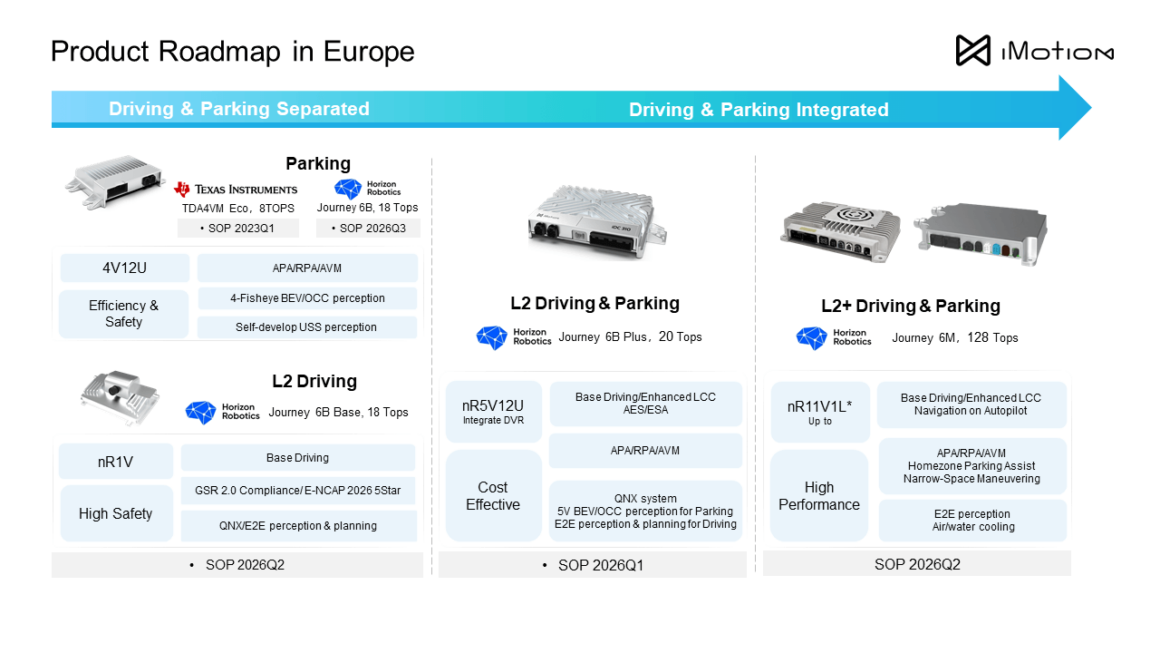
For the EU market, iMotion offers driving & parking solutions, separate or integrated. For entry levels, we have the iDC100 based on the TDA4 series, or Horizon Journey 6B for parking and AVM functions, iFC 4.0 based on Horizon Journey 6B for base driving, iDC 310 based on Horizon Journey 6B for base driving and parking function integrated. Apart from intelligent front camera using Mobileye EQ4, we have solutions using Chinese chips, e.g. Horizon J6B.
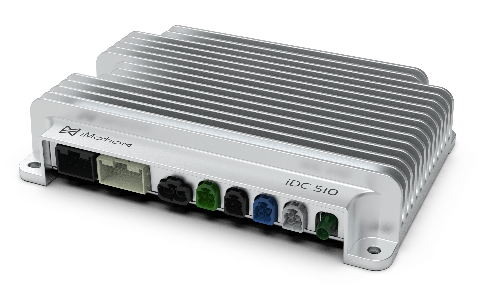
For the upper ADAS levels, we offer iDC510 Pro based on Horizon J6M-128TOPS SoC with Highway NOA and HPA functions.
IMotion’s sensing technologies focus on vision perception, but we also offer vision and radar/USS fusion solutions.
DVN: How about for China, what does your offering look like now and for the future?
U.L.: Safety is always the same requirement from China and EU market. Horizon Journey 6B could address extreme scenarios due to AI-powered image enhancement, E2E perception combining Sparse 4D and 3D OCC. Shifting from Linux to QNX enables the system to ASIL D compliance and to meet EU cybersecurity requirement.
DVN: What products are in production now, what companies do you work with, and how?
U.L.: There are about 10 products already in production. Smart camera based on Horizon Journey 3, parking solution based on TI TDA4 and V4H, driving and parking integraed solution based on Horizon Journey 3 plus TDA4. High-compute platform driving and parking integrated solution based on Horizon Journey 6M. The new generation cost-effective driving and parking integraed solution based on Horizon Journey 6B will be in mass production in March 2026.
The majority of our customers are from China: Geely, Chery, Leapmotor, Great Wall, and so on, but for global market we also provide ADAS solution to Hyundai and Proton (Malaysia).
iMotion maintains an open attitude toward different business models. We can provide:
- Full-stack hardware and software solutions, also known as turnkey projects. We provide integrated platform solutions covering the hardware and functional software required for intelligent driving.
- Hardware and base software delivery: depending on customer needs, we can flexibly provide hardware design, base software development, or customized production
- Functional algorithm modules: we can provide specific algorithms or functional modules based on customer requirements. Typical examples include APA (Automatic Parking Assist), BEV parking perception, ultrasonic perception, ISP tuning, AVM (Around View Monitor), and HMI (Human-Machine Interaction) applications. These also represent our unique advantages that distinguish us from traditional hardware suppliers.
- Engineering and technical consulting: we can offer services such as validation support, data collection and labeling, and data closed-loop toolchains to meet customer needs. IMotion’s products and services can be provided as integrated solutions or modular components, aiming to pool resources and achieve breakthroughs through collaboration with customers.
DVN: What differentiates your ADAS domain controllers from others?
U.L.: Full-stack in-house R&D capabilities support a highly flexible modular and integrated sales-service model. Mass-production oriented and market-driven, iMotion’s algorithm design, software architecture, hardware design and manufacturing all thoroughly consider resource consumption. Deliver high value and quality products through systematic engineering optimization.
DVN: How do you affordably ensure real-time perception accuracy in complex environments?
U.L.: In 2024, with the adoption of BEV perception and model-based prediction modules, we successfully implemented high-level driving and parking functionalities on mid-to-low computing power platforms. The core work in 2025 was to fully restructure the algorithmic architecture on mid-level computing power platforms (around 100 TOPS) for application scenarios such as highway and urban mapless NOA (Navigate on Autopilot). This will involve achieving a two-stage end-to-end system with model-based coupling of perception and decision-making, complemented by rule-based safety redundancy design. By 2026, the two-stage end-to-end system will be further upgraded to a single-stage end-to-end system, enabling direct mapping from pixels to steering commands and achieving full-scenario, garage-to-garage intelligent assisted driving (featuring spatiotemporal context encoding + lightweight trajectory generation).
DVN: Your Bird’s Eye View 3D perception technology: how does it differ to other surround-view systems?
U.L.: Traditional CNN (convolutional neural networks) lack spatio-temporal fusion, resulting in poor prediction on dynamic objects. So they’re limited in multi-task handling, therefore not able to adapt to complex situations. IMotion Bird’s Eye View (BEV) + Transformer + OCC (occupancy-based scene representation) ensures one-time raw data fusion by all sensors, and spatio-temporal perception, avoiding the scale and occlusion in the image. Occupancy-based representation helps general object recognition and scene generalization.
IMotion’s BEV solution fully leverages the multi-core architecture of the TDA4 chip. The overall BEV solution is designed with a dedicated backbone network and deployed on TI’s NPU (neural processing unit). Perception tasks such as 2D-to-3D conversion are then processed via the DSP, which directly outputs detection results including parking space boundaries, obstacle positions, and OCC grid maps. As far as we know, iMotion is the first company to deploy BEV perception on TDA4 SoC and mass-produce in global marketComparing to traditional CNN perception, BEV perception has the advantage of more types of objects detection and longer detection distance.
DVN: How do you balance advanced features like Automated Home Parking and Highway Pilot with affordability for mid-range and entry-level vehicles?
U.L.: Democratization of high-level ADAS is happening in China. SoC are becoming more powerful and more affordable, and the feature experience keeps getting better. The same trend is set to take hold in Europe. ADAS solutions are moving from multi-SOC to single-SoC architectures drives further cost reductions.
DVN: How do collaborations shape your ADAS roadmap? Do you foresee deeper partnerships?
U.L.: IMotion is the first company to achieve ADAS mass-production on Renesas V4H, only one SoC. IMotion and Renesas are deeply and closely collaborate during the development period, to leverage DSP for 2D-to-3D image processing and customized operator for iMotion.Besides Renesas, iMotion has the capability to rapidly deploy algorithms on different SOCs – Horizon J3/J6B/J6M and TI TDA4. IMotion has full-stack capability of driving and parking, Highway NOA has started production in China and delivered over 100k, and we plan to mass produce urban function in China in Q3 of 2026.
IMotion has a very open and flexible business model with all partners. iMotion’s products and services can be provided as integrated solutions or modular components, aiming to pool resources and achieve breakthroughs through collaboration with customers. There have been some successful cases and numerous projects are under development.
DVN: What is your vision for transitioning from ADAS to higher levels of autonomy?
U.L.: In China, L3 highway NOA will be in mass production in 2026; two automakers have got L3 road access permission. L4 robotaxis have been in commercial operation in many cities for many years, and our vision is that L4 passenger cars will enter mass production before 2030. Safety is always the most important and hardware/software redundancy is the guarantee of safety.
DVN: All very exciting! Ulrich, thanks for sharing your thoughts.


