Joachim Tiedecke is a technical expert developing sensing technologies, and inventor of Senslight technology.
His career has had him in management positions including Head of Development of the Sensor Solutions division, then Head of Corporate Technologies at Baumer (industrial automation sensors); CTO for Driving Assistance at Siemens VDO Automotive; Managing Partner at IDM (industrial sensors), and Head of Laser Development at ADC (automotive sensors). He graciously talked with us about his work and his newest innovation.
DVN: Tell us about SensLight.
J. Tiedeke: SensLight was developed under strict focus on sensor and integration cost. Our goal was not to create the best possible optical sensor, but rather the most affordable feature for car buyers—offering functions compelling enough to make purchasing a well-equipped vehicle attractive. Since we are all car buyers ourselves, it wasn’t difficult to estimate the kind of budget people typically have for optional features. For a function that is not widely known but sounds interesting, we assumed a purchase price range of €150 to €250 as realistic from a car buyer’s perspective.
With this in mind, we started thinking about how to design a sensor that can meet both the technical requirements and the cost expectations of typical car buyers. The idea was to make use of existing components of the vehicle—specifically the lighting system—and equip it with sensing capabilities. The result will be a light with dual functionality: illumination and sensing.
We asked ourselves what’s possible using vehicle lights, specifically LEDs. We investigated the feasibility of modulating LEDs, in terms of the amount of light they can emit, both from a physical perspective and within the boundaries of regulations. We discovered that semiconductor LEDs can, in theory, be modulated up to 490 MHz, but practical limitations such as parasitic capacitance and wiring inductance reduce that range. Our investigations showed that modulation is feasible at a minimum of at least 35 MHz, typically around 100 MHz, and up to a maximum of 250 MHz.
Compared to the laser sensors we had developed previously, here are the results:

So, we looked for a technique that could operate with lower peak power but higher average power and high modulation frequencies. Based on our extensive experience with radar sensors, we came up with the idea of adapting radar principles to SensLight. We applied a chirp signal to the LEDs, received it back, and mixed it with the transmitted signal. This approach gave us a signal:noise ratio (SNR) gain of approximately 180.
There are fundamental differences between SensLight and conventional optical sensing. SensLight operates using the light output of standard automotive LEDs. It is not just a sensor placed inside a light, but a fully-integral system with components shared for lighting and sensing. This results in significantly lower sensor cost, and very significantly lower integration costs. And SensLight is extremely fast. Detection times—even for the entire field of view—can be as short as 33 µs.
DVN: What are the main advantages of SensLight for ADAS and automated driving functions?
J.T.:
• Costs at a level that enables attractive functions, which will be accepted price wise by a large number of car buyers.
• Extremely fast: while lidar with oversampling typically requires around 40 ms, SensLight achieves results in just 33 µs. The benefits are no motion blur, and consistent and reliable data.
• High bandwidth enables visibility through e.g. fog, and simultaneous measurement of e.g. fog density via backscatter.
• No issues with highly reflective targets at long distances; SensLight can distinguish objects up to 9.8 km away.
• 360° coverage is easily achievable, as lights are typically distributed all around the vehicle.
• Sensors are seamlessly integrated into the lights, invisible to the outside. No additional hardware mounted on the roof (for example), therefore unique design and cost advantages.

DVN: How does SensLight use existing LEDs in vehicles for detection and measurement?
J.T.: The existing LED chips are combined with a dedicated driver circuit, fully integrated into a single chip. This circuit operates directly from the vehicle’s power supply and also manages the lighting functions. As a result, separate light control units become obsolete. Various modulation schemes are possible; chirp or FMCW are among the easiest to implement and understand.
DVN: What types of lamps and sensors are compatible with SensLight technology?
J.T.: All types of LEDs can be used — not just white, but also red, and for long-range detection, infrared (IR) as well. Using IR helps avoid glare or blinding effects at distances beyond 80 meters. SensLight is designed to operate reliably at ranges exceeding 200 meters. Therefore all LED lamps can be used for SensLight, and with SensLight all ADAS related sensors can be realized, except cameras.
DVN: What is the range and angular resolution of the different types of lights used by SensLight?
J.T.:This depends on the specific design, but ranges beyond 200 meters and angular resolutions of 0.1° are achievable. From a cost perspective, it is crucial to tailor the sensor layout precisely to the functional requirements.
DVN: How does SensLight perform in challenging environments like fog or splashes? Does its wavelength offer specific benefits versus IR?
J.T.: No, it is not primarily the wavelength that determines performance in poor weather conditions, but rather the system’s ability to manage dynamics and bandwidth effectively. SensLight sensors are designed to operate reliably in all weather conditions. The performance in adverse weather conditions is comparable with Active Gated Imaging or radar.
DVN: What are the costs associated with the integration of SensLight into vehicles?
J.T.: We are currently under NDA and therefore cannot publish detailed calculations. However, initial estimates indicate that the sensor cost is comparable to that of ultrasonic sensors, but SensLight offers significantly lower integration costs. In addition, SensLight sensors provide three times the range, far superior angular resolution, full-driving-speed capability, and much faster response times.
DVN: What’s the patent situation?
J.T.: There are patents filed between 2013 and 2019, together with an OEM. Nevertheless, industrialization with other OEMs and suppliers is intended.
DVN: What tests have been done with this technology?
J.T.: Based on our experience with other lidar sensors and validated computer models from previous developments, we have simulated the SensLight sensor approach. In addition, we have built a technology demonstrator that performs measurements in real-world environments. Although the demonstrator is not yet fully optimized, it already delivers superior results and provides valuable insight into the SensLight methodology.
The next step will be a proof-of-concept (PoC) phase, in which a multi-channel setup is developed with dimensions close to the final product. This PoC prototype will enable relevant testing, and the resulting data can then be compared directly with our simulation results.
SensLight was developed in collaboration with an OEM and the concept has been reviewed by several tier-1 and -2 suppliers. So far, no one has identified a critical flaw or killer argument against the approach.
DVN: When could a representative prototype be ready? Where do you intend to break into the market?
J.T.: Currently the [co-patenting] OEM is in discussions with the selected tier-1 supplier, clarifying the industrialization process. Right now we cannot talk about the timing.
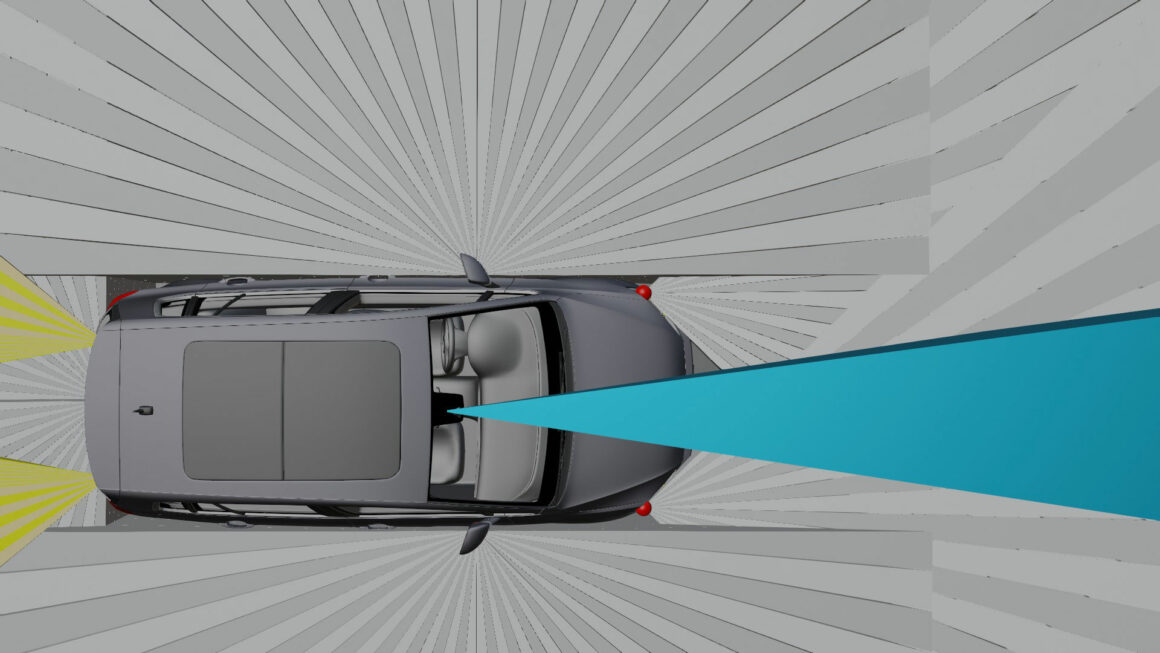
The layout is primarily configured for parking, but can also support other functions. The differently-colored segments shown here represent independent measurement segments of the sensor. The measurement fields are also structured in depth in the same way.
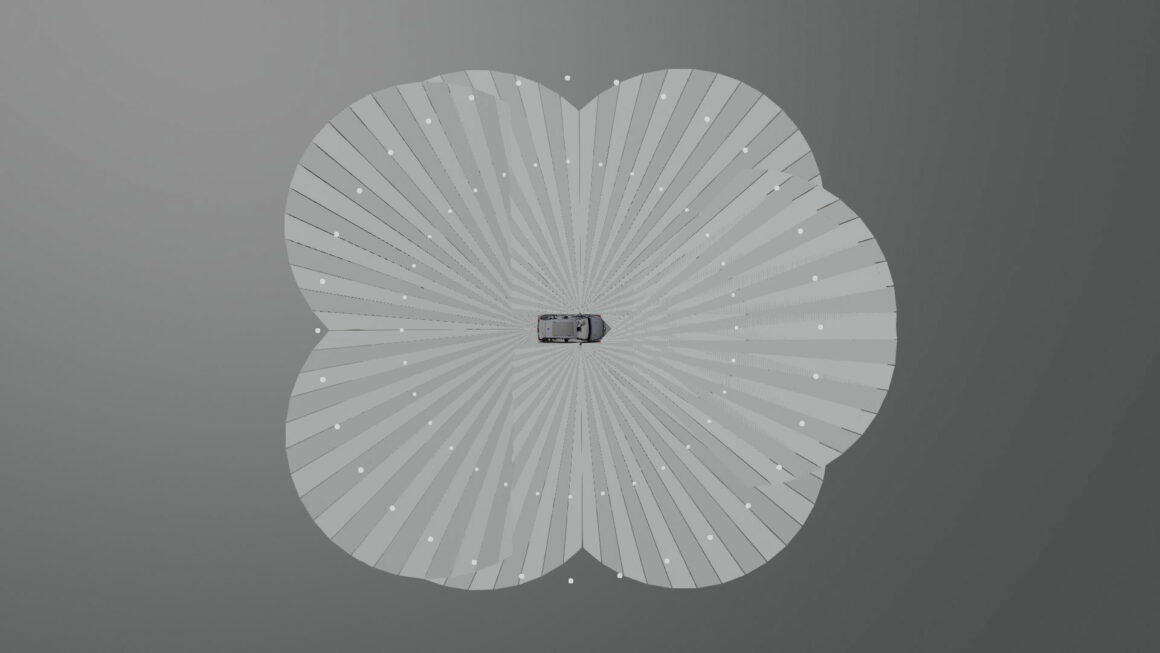
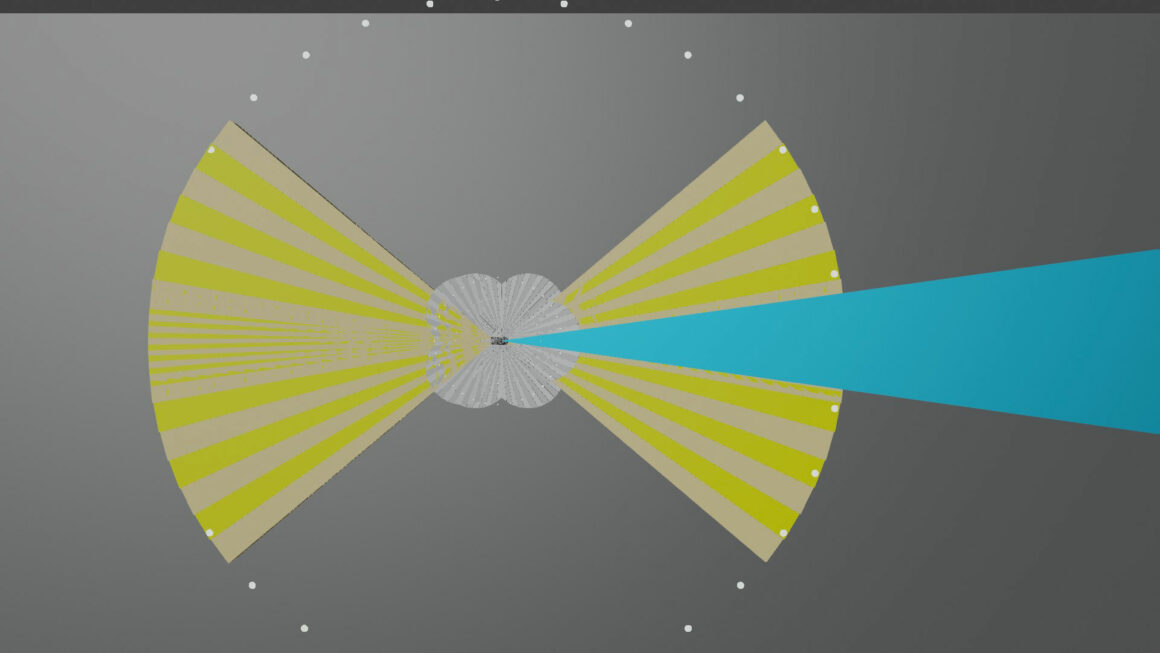
The car in the images here has:
- four mid-range sensors with 80-m range (two front sensors in the DRLs, two rear sensors in the 3rd brake light)
- short-range parking configuration
- •1 wide-range front sensor with vision enhancement, based on IR lighting (to avoid glare) installed near the front camera