
Nicolas Lio Soon Shun joined CEA in 2015 as a partnership manager for thermal and terahertz imaging. He is dedicated to creating long-term partnerships in these fields, especially with end-users in the frame of European projects.
DVN: Hi, Nicolas! Can you tell us about CEA-LETI’s activities?
Nicolas L.S. Shun: The Laboratory for Electronics & Information Technology (CEA-Leti), is an institute of CEA, a French research-and-technology organization with activities in energy, IT, healthcare, defence and security. CEA-LETI is focused on creating value and innovation through technology transfer to its industrial partners. It specializes in micro and nanotechnologies and their applications, from wireless devices and systems, to biology, healthcare and photonics. Microelectronics, M&NEMS (micro- and nanoelectromechanical systems), and photonics are at the core of our activities. The Department of Optics and Photonics focuses on the development of imagers (visible light, infrared, THz), silicon photonic components for communication and computing, displays and optical systems, miniaturized optical sensors, and photonic systems.
Since the 1990s, CEA-LETI has advanced uncooled microbolometer technology, focusing on sensing material, electro-optical tests, vacuum packaging, pixel architecture, and readout circuits.
DVN: What is LWIR imaging and how does it work?
N.L.S.S.: Human eyes see what is called the visible band, ranging from 0.4 µm to 0.8 µm within the electromagnetic spectrum. Longwave infrared imaging usually spans from 8 to 14 µm. The higher the temperature of an object, the more photons it emits, and the shorter the peak wavelength of the emissions. For example, objects at room temperature have their peak emissions around 10 µm.
DVN: In a LWIR imager, how are waves collected and detected? What’s the resolution, the spectral response?
N.L.S.S.: Microbolometers are the most common type of devices used to image in the LWIR band. A microbolometer pixel consists in a thin suspended membrane composed of a material sensitive to the LWIR band called the absorber, and of another material which properties changed according to the temperature. This membrane is connected and thermally isolated to the readout circuit and the overall pixel is put under vacuum.
DVN: How can LWIR imaging be used in automotive applications, Particularly in ADAS/AD where long range and precise detection is required?
N.L.S.S.: Most vehicles with ADAS are equipped with visible cameras or radars, both being low-cost. But those sensors need an additional light source. Visible cameras are good at detecting objects, classifying. Radars are good at sensing and ranging objects but not classifying them.
In the LWIR range, objects themselves naturally emit photons in this range, no need for any external illumination source. Thermal cameras are able to detect objects in any light conditions. This will improve the capabilities of automatic driving and especially in automatic emergency braking systems.
According to a report by the European Road Safety Observatory, thousands of pedestrian fatalities happen per year, of which 18 per cent occur at night. Multiple car makers have already integrated thermal imaging in luxury cars for night vision such as the Rolls-Royce Wraith, BMW 7-series, Mercedes-Benz S-Class, Volkswagen Touareg, and Audi A6.
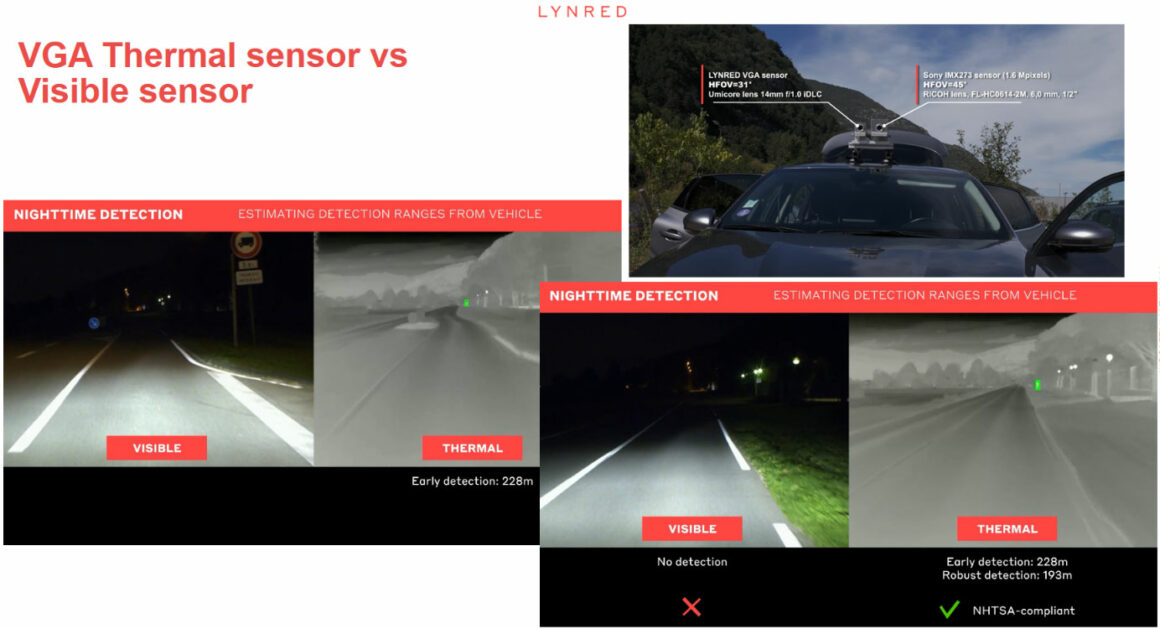
In the U.S., NHTSA’s new FMVSS № 127 was adopted by the US congress for mandatory implementation by September 2029. Tests made by LYNRED have shown their thermal imagers are compliant with the NHTSA standard, allowing for early detection of VRU further than 200 m.
DVN: What are the key advantages of CEA-LETI’s LWIR imaging technology?
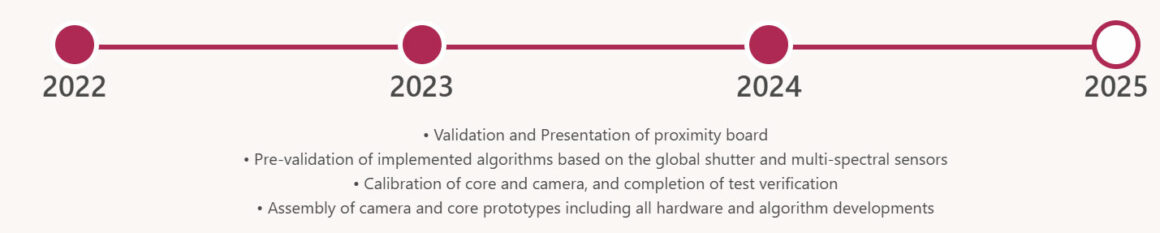
N.L.S.S.: CEA-LETI and LYNRED, the spinoff of CEA-LETI which manufactures and develops new generations of thermal imagers, are constantly working on improving thermal imagers’ performance. An overview of this development is available on the BRIGHTER web page.
DVN: Do you have partnerships with automotive suppliers?
N.L.S.S.: CEA has partnerships with tier-1s and OEMs, but we are lacking OEM/tier-1 partners for this specific project.
DVN: When might we see a proof of concept / validated prototype?
N.L.S.S.: A consortium of European partners is currently gathering in order to develop a thermal perception system surpassing the NHTSA/ Euro NCAP nighttime AEB requirements.
DVN: Thank you for your time!


