
Mitsuyoshi Naritomi used to work at Nissan, where he led the complete interior / exterior team He joined Marelli recently as Engineering VP.
Paul-Henri Matha for DVN: Naritomi-san, it is a pleasure to talk with your before DVN Tokyo workshop happening this week. Could you introduce yourself, your background, and your new job at Marelli Japan?
Mitsuyoshi Naritomi: I served as General Manager of Interior and Exterior Engineering at Nissan until April 2020, where I worked closely with Marc Geissmann of Renault on alliance activities involving interiors, lamps, seats, HVAC systems, and more to create synergies across the two companies.
In April 2020, I joined Marelli as Head of R&D for the Interior Division. I am responsible for innovation and product development in areas such as cockpit modules, instrument panels, cross-car beams, and consoles — this includes interior lighting as one of our key development areas.
DVN: We will have, for the first time in Japan, a DVN session about interior lighting. Can you tell us about recent innovations in the field?
M.N.: The adoption of RGB-LED technology has significantly diversified the range of lighting colors, enhancing both functional aspects — such as HMI and entertainment — and the overall ambiance of the cabin. In combination with decorative panels, interior lighting now also contributes to enhanced surface æsthetics.
DVN: How is Marelli involved in this field? is it part of Marelli Automotive Lighting, or a separate division?
M.N.: Interior lighting is positioned as a key product within Marelli’s Interior Division, and we are actively expanding our business in this domain.
DVN: Do Japanese buyers have specific wants and needs for interior lighting, or does Japan follow the global trends of RGB, light interaction with music, ADAS, lighting activation, phone, etc?
M.N.: Currently, our product development in interior lighting aligns with global trends in terms of functionality. However, when it comes to ambiance and emotional expression, we are exploring wellness-oriented designs that reflect uniquely Japanese sensibilities.
DVN: How do you see the evolution of the smart RGB? They are still expensive, and each LED supplier and every LED IC supplier use their own protocol. Is it time for standardization?
M.N.: Smart RGB enables coordinated control of multiple LEDs across the IP, doors, and roof, allowing for more immersive lighting effects. At the same time, standardization of control protocols will help streamline system architecture and reduce overall costs.
DVN: I perceive a shift in OEM budgeting, from exterior to interior lighting. Do you think that’s happening, particularly given the push by Chinese OEMs who focus more on interior?
M.N.: While there is growing use of illuminated exterior emblems and continued advancement in high-performance exterior lamps, the overall budget for exterior lighting has not decreased. At the same time, to enhance perceived interior value, ambient and functional lighting applications are clearly on the rise. In China, interior lighting adoption increased significantly after 2023 and is now reaching a more mature phase. Recently, OEMs tended to favor cost-effective yet value-adding features, shifting some budgets toward entertainment and other experiential functions.
DVN: What do you think about smart surfaces, including haptic activation, flexible PCBs with printed electronics, and that sort of thing? We see a lot of demos at events like CES, but just a few applications so far. Why is that?
M.N.: At Marelli, we mass-produced the world’s first large decorative haptic switch panel for the Nissan Ariya, using two proprietary technologies: one for haptic transmission and another for force sensing.
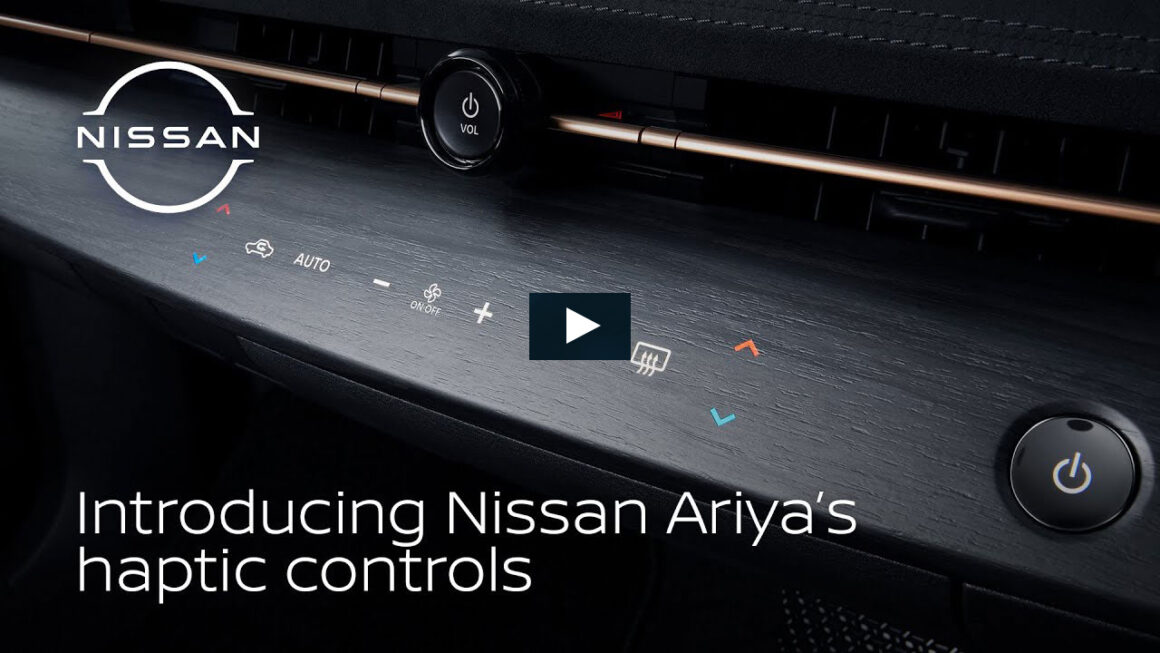
While traditional physical switches are defined by force parameters, smart surfaces require distance-based sensing. The key technical challenge lies in ensuring consistent tactile feedback—especially when factors like glove use change the finger-to-surface distance. We’ve developed proprietary know-how to address these variations in user interaction.
DVN: What do you think about mini- and microLEDs, will those come to interior lighting?
M.N.: Thanks to their fine pitch, miniLED and microLED technologies offer high brightness and resolution, enabling display quality close to that of LCDs. While their strength lies in high-resolution displays, we do not expect significant expansion into ambient interior lighting applications.
DVN: What about projection technology; what is the feedback from automakers?
M.N.: At present, projection technology remains more costly than LED lighting or TFT displays. OEMs generally consider static image projection, such as what’s used in the BMW MINI, to have limited functionality and thus lower priority. Instead, there’s growing interest in seamless, dynamic 3D projections spanning from the IP to the doors—this immersive type of content is what OEMs are starting to prioritize.


