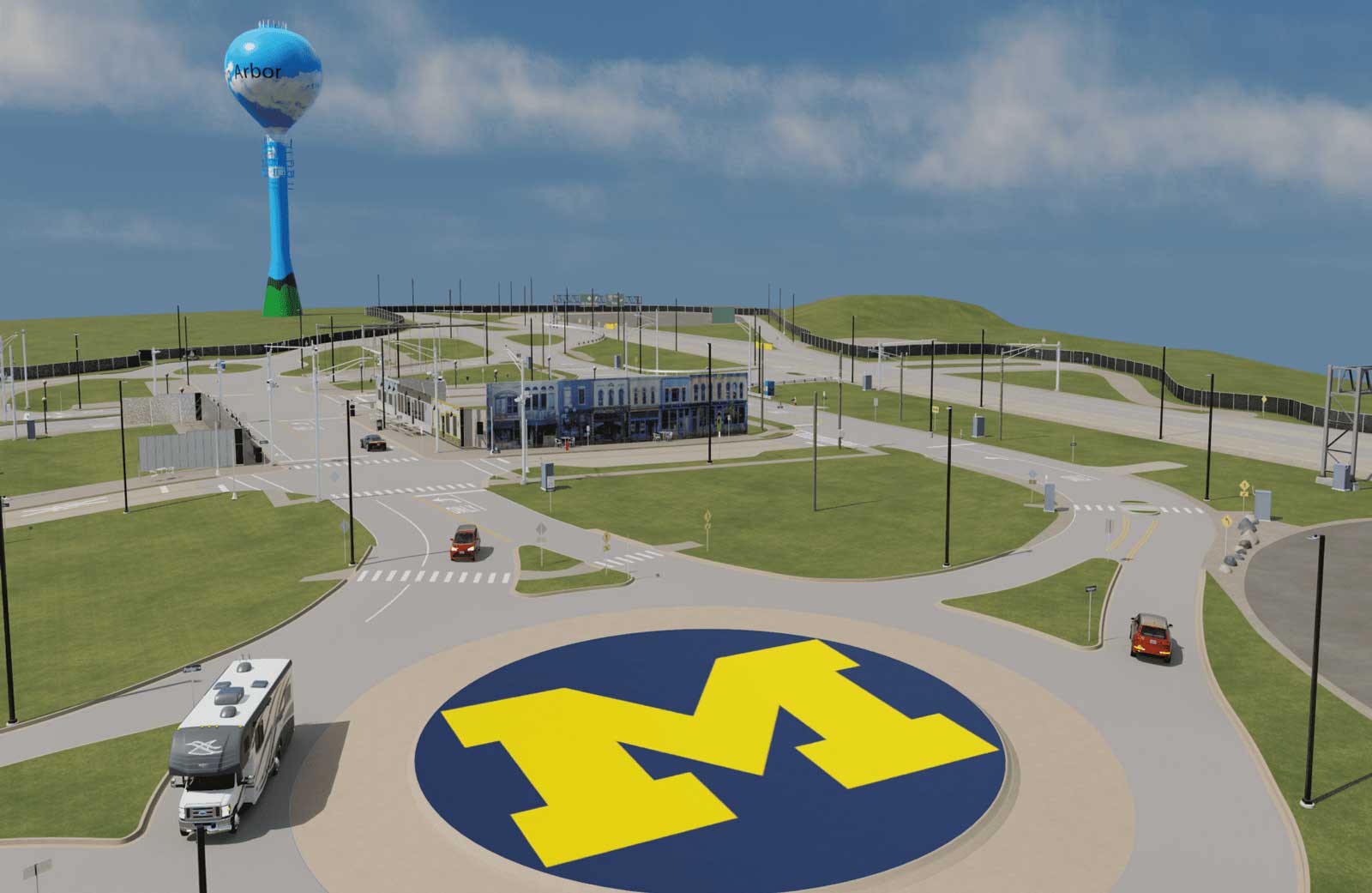
During our trip to Detroit, we made a visit to the University of Michigan’s Mcity facility and spent some time with Greg McGuire, Managing Director of Mcity. Mcity is a public/private partnership between the University, Michigan DOT and commercial partners that started about a decade ago to test V2X technology. It has since branched to research and testing on various autonomous projects and is currently focused on how to close the gap between simulation and the real-world.
Mcity is part of the University of Michigan’s Transportation Institute and has around 25 scientists plus support staff. Part of the facility is an 18 acre test track area and they have worked with Nvidia to create a digital twin of the facility and open source tools that allow OEMs and researchers to run their AV simulations on the digital twin environment.
Greg told us that one of the big issues in the US market with AV adoption is that there is no framework for testing and certifying L3/L4 driving. OEMs are currently self-certifying, and most are not very transparent about how they have tested and what the criteria to certify are. There is a need for some organization like SAE or Mcity to bring the industry together to agree on such frameworks and tests and then have a body like TuV supervise and certify such tests. China and the EU are likely to be ahead in regulating this.
Simulation tools have become key to developing AV software, rather than collect data from millions of miles driven in the real world. In the simulated environment you can focus on crash and near miss scenarios, add challenging weather conditions and other corner cases that lead to accidents. The simulation challenge however is how close this correlates to the real world. If you change an end-end AI driving model everything has to be re-tested which is not possible in the real-world due to time constraints, so an accurate simulator becomes key.
Mcity’s digital twin has been developed with Nvidia and is available as an open source version and has been used by six or seven simulation vendors. Realistic modelling of sensors is key and Nvidia provides such models from its partners. Terra SIM is another open source model that allows the environment to simulate other driver (bad) behavior and create safety critical events that can be tested in the digital twin environment.
Radar has been the hardest sensor to simulate, however, this is getting easier with HD Radar.
The test facility is also used by a lot of start-ups, some of which are funded by the State Office of Future Mobility and Electrification. Mcity performed a safety assessment for May Mobility and the DOT before a trial shuttle service was rolled out in the City of Detroit. There are many other projects, funded by NSF, DARPA and others that are on-going.

The Mcity facility is a useful resource for OEMs, Tier1’s, sensor and software vendors. Most of the research is focused on what is coming 5 years down the pipe and Greg encourages other industry players to join the consortium. You can contact Greg and Mcity at mcguireg@umich.edu.


