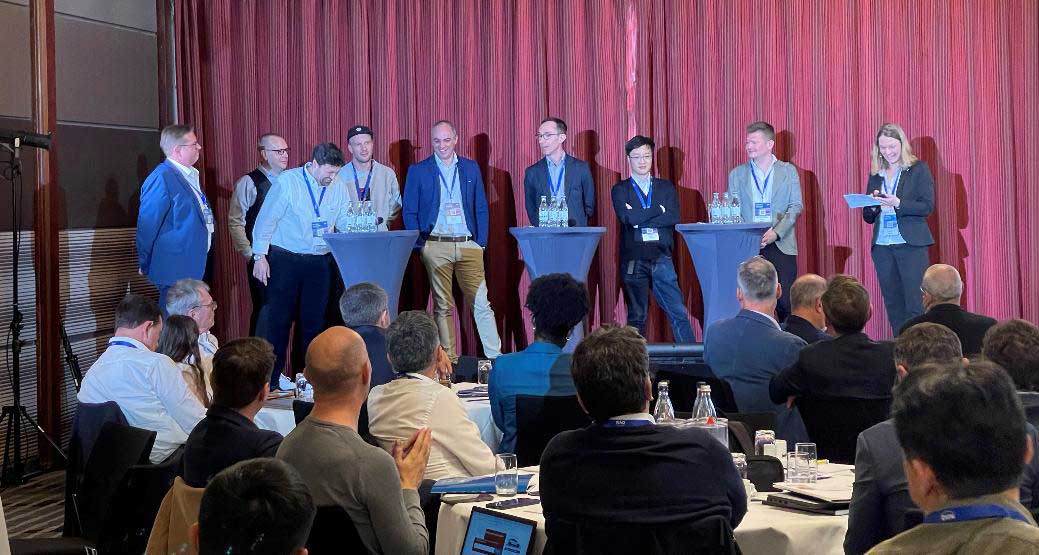
The seating session covered a broad perspective on seat benchmarking, regional evolution, and technology. Technology highlights included haptics, seat sensors, gamification for more active posture, safe monitoring of child seats, carbon-reduced seat structure, and regional evolutionary forks—such as the Chinese-market importance of seats as a pillar of the mobile environment—which are influencing the global market
Seat Benchmarking Highlights Europe/Asia
(Arnaud Goy, A2Mac1 / LMI)

A2MAC1 provides full coverage and detailed analysis of best-in-class designs in the worldwide automotive market, and LMI—part of BSCA Group, as DVN is—provides unique market intelligence solutions. The two organizations together provided deep, reliable, up-to-date data and understanding of seating products and strategies.
Arnaud’s presentation emphasized striking design examples such as the Tesla Model 3 rear seats, reflecting cost optimization with features like custom metal profile and special mounting devices, and BYD perceived quality via their flexible lid with i-Size Logo realized as 2K-component, instead of printed on the trim part.
These examples illustrate how to understand design strategies, trade-offs, and market-specific solutions.
The Throne on Wheels
(Guang Yang, Diconium, a VW company)

This first lecture of the seating session, which focused on the evolution of car seating in China, was already covered in DVN-I Newsletter № 256, two weeks ago.
To recap, Guang Yang studies the differences between user needs and wants in western countries and China, driven by historical reasons and social environments.
While in Europe car history dates more than 100 years back, in China cars became a popular (and generally-attainable) item just 20 years ago. That means Chinese and western perceptions of the car aren’t the same. Europeans like a comfortable and modern car, but it is mainly a tool to move, a transport appliance, becoming recently an extension of home features but still not as important as a home. For Chinese people, the car is more than a simple means of transport; it is a symbol of social status and lifestyle, and a space for rest and entertainment for the whole family. In Europe the typical family is parents and kids, but in China 13 per cent of population have families with 2 or 3 generations living together. So the car is a mobile office and a second living room: 3 generations, one family, a mix of work and life blended together.
In that context, seating is a very important part of the car: a seat should welcome you, and offer you comfort during your trips. It should allow you to relax and to work without stress, and to take a nap during long rides. The rear seat is more important than front seat, because the boss sits in the back (the ‘boss seat’, so to speak).

So, four key takeaways for developing a car seat for China are:
- Design for the rear first
- Flexibility is essential
- Lifestyle integration matters
- Culture shape expectations
These are great insights for western OEMs wanting to compete with Chinese ones.
Seat Haptics
(Fady Youssef, Grewus)

Grewus is a company specializing in haptics and acoustics. They’ve been developing haptics for smart surfaces, as an alternative to physical buttons.
Haptics spurs fast, intuitive response from users. It is non-visual and has different degrees of sensitivities. It is applied today to diverse areas like entertainment gamification, multimodal user interfaces, and seating.
Haptics integration in seats is now easily done thanks to new modular actuators designed to allow flexible integration. They enable a broader frequency range and a higher definition haptic response, and haptic patterns can be customized.
As EuroNCAP is now demanding buttons for safety features, a smart seating haptics application could become an alternative to warn the driver with vibrations about dangerous driving situations, like drifting from lane or exhibiting signs of fatigue.
Haptic seating is now a trend!
Seating Position Sensors
(Oliver Kuerten, Polycontact)
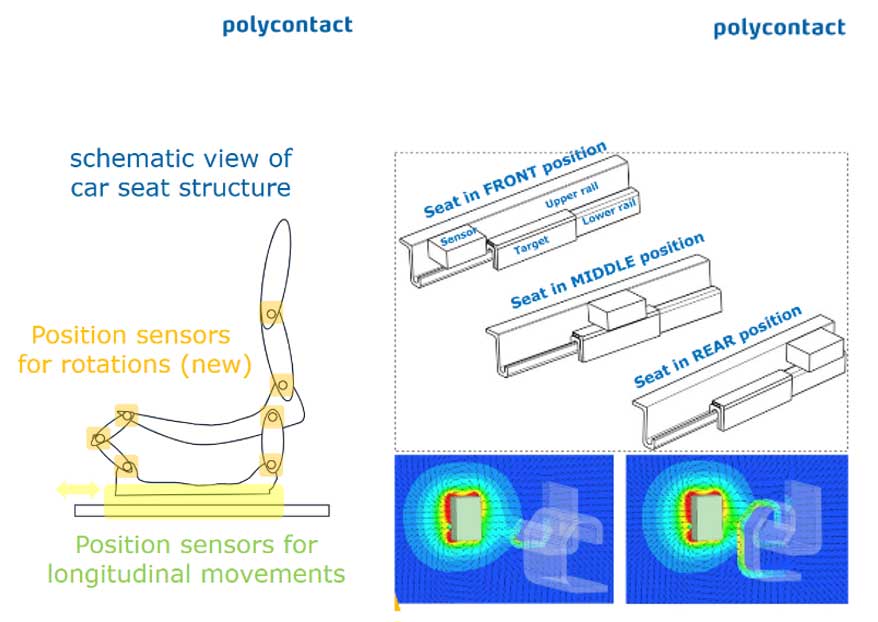
Polycontact is a company of experts in seat position sensing, providing different types of solutions, from seat tracking sensing to position sensing, together with electronics and lighting-seating integration.
Seat position sensing is attached to the seat structure and connected to the airbag control units. Seat track position sensors, called for by NCAP, are positioned in front rear and middle position of tracks.
Linear position sensors are the best from safety perspective, detecting the seating positions to tune the airbag deployment parameters.
With autonomous driving, the seat position sensing is going to be much more variable, and it could be integrated with lighting to provide additional functions like:
- Dynamic light adaptation, with illumination changing to seating and driving status
- Safety signalling, to indicate incorrect seating configurations
- Visual comfort and safety, with real-time feedback on ergonomic adjustments
- Personalization, with driver and passenger lighting setting preferences
Sensor-Based In-Seat Gaming
(René Wegner, Headis)

Headis is a startup company in sport studies. Dr. René Wegner introduced his innovation regarding the integration of sensors in seating to support gamified physical activity.
Becoming active in a passive environment—such as being seated as a driver—has health benefits: exercising and flexing back muscles allows relaxation and reduce risks of injuries and pain for the lower spine.
The sensors integrated in the seat generates vibrations to allow playing a game like Tetris with back movements, with visual, audio and tactile instructions guiding you through the exercises.
The sensors can be also used as DMS, to detect wrong sitting positions or fatigue, sending the driver or passenger vibrations to inform about the need to change the positions. For the automaker there could be also potential savings due to reduced number of sensors or cameras, and health insurance compensation for the driver for health prevention activities.
The project from Headis was EU-funded, and the company is looking now for support to integrate the innovation in the automotive field.
Smart & Safe Child Seat
(Francesco Ruocco, Italdesign)

Italdesign has an innovation in child seats. Some background: since the U.S. introduced minimum standards for in-car child safety in 1971, the number of injuries and death has decreased. In 2002 the isofix international standard for attachment points for child safety seats was introduced, further reducing the death rates, but since then no additional decrease has been registered. The is a warning for car manufacturers that it is time to introduce some new innovations…!

According to US Police data, in 75 per cent of relevant cases the child seat is not properly installed, and 54 to 71 per cent of fatal injuries could have been avoided if the child seat had been properly installed and adjusted. But there is no feedback to the driver informing that the seat has not been properly installed, or, even worse, that the child has unfastened the seat belt.

Italdesign decided to study how to improve the situation, considering also that the DMS being developed and deployed today don’t detect child-seat faults like these.
Italdesign’s engineering team developed a smart child seat system that detects if the child seat is properly placed and if the child has unfastened the restraints.
Key information provided to the driver includes
- The child seat is correctly engaged with the isofix mounts in the car
- The child is on the child seat
- The child is wearing the seat belt
With this type of communication — child seat to infotainment and infotainment to driver, with audio warnings and smartphone messages — it’s also possible to be informed of an unfastened seat belt during driving, or if a child is still sitting in his seat when the driver is leaving the car (anti-abandonment function).
All this information is fed to the car via CAN, combining the mechanical connector of isofix, an electronic connection, and the tilting system of the isofix. The innovation could also be used to integrate other functionalities, and it can be integrated on all types and groups of child seats.
Italdesign also presented, in their expo booth, a bag-in-belt solution, all the innovations to be safer in your vehicle.
Emission-Reduced Steel for Use in Car Interiors
(Uwe Wolf, SSAB Europe)

SSAB is a steel producer. Uwe Wolf highlighted the fact the demand for steel is going to increase a lot until 2050, and the recycling of existing steel will not be enough to satisfy the global demand.
New steelmaking processes are needed, because traditional method improvements will not be enough to avoid the increase of CO2 emissions. SSAB has invented a new zero-fossil-fuel steel production process called HYBRIT. The steel reduction is made with H2 (hydrogen), and during the manufacturing process only water is produced — no CO2.
The resultant steel has the same properties as conventional steel, and it can be produced using both recycled steel and iron ore. Steel made with the new SSAB process has been already adopted by Daimler, who will source CO2-free steel starting from 2026.
SSAB had developed a unique sustainable steel offer, with zero emissions in operation including purchased material!


