How to Design Interiors With Innovative Circular Material Solutions
Alessia Pierini · Dow Mobility Science
Dow has introduced a series of innovations helping to build the ecosystem for automotive circularity, including:
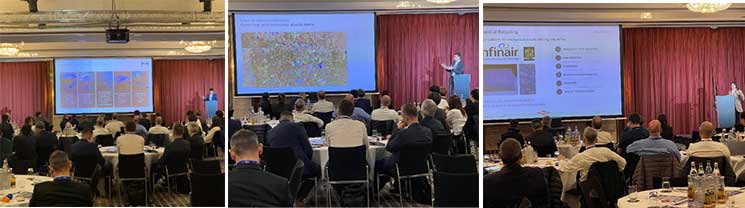
Infinair polymers for loop technology: polyolefins that allow to design automotive cushions prioritizing circularity, through mechanical recycling.

Specflex CYR uses recycled waste from the automotive industry, with identical performance to the original material, to produce circular polyurethane-based products matching the same original performance, enabling 75-per-cent circularity on polyol and 60 per cent on MDI.

Dow also informed about their latest recycling programs: Renuva Closed Loop and Renuva Open Loop.The first program is a cooperation between Dow, Adient, and JLR, one of the first ones in the automotive world, aiming to reduce CO2 footprint and promote sustainability through closed-loop recycled components.
The program recycles seating PU foam, which is depolymerized, resulting in a liquid polyol also branded Renuva, which contains up to 50 per cent recycled content.

The Renuva Open Loop recycling program uses recycled PU foam from postconsumer mattresses. It’s turned into Renuva polyols, with a significant cutdown on environmental footprint.

The Aesthetics of Recycled PP — New Opportunities and Challenges
Georg Grestenberger · Borealis
Mr. Grestenberger’s introduction was focused on the recent EU circular design and end-of-Life regulation, calling for 25 per cent by weight of recycled plastic in new vehicles (with a proposal from the European Parliament to lower this to 20 per cent), a quarter of which must originate from recycled vehicles.
Borealis makes polypropylene (pp), which represents 54 per ent of the plastic contained in an auto interior. Recycled PP for interior applications is therefore key to achieve the target, whether it be 20 or 25 per cent.

Borealis has introduced their PCR PP from closed and open loop mechanical recycling; their Borcycle family includes three types of PCR PP:
• EE1300SY is a mineral-filled PP compound with 30 per cent recycled polymer from postconsumer waste, which can be used for claddings and trim.
• EE0300SY isa low-density mineral-filled PP compound containing 30 per cent recycled polymer from postconsumer waste, used for claddings and trim.
• MG1416SY is a lightweight, mineral-filled PP compound containing 40 per cent recycled polymer from postconsumer waste, suitable for inserts and trim.

Grestenberger also said the latest generations of PCR compounds can be provided in various colors, but the brighter the colors, the harder it is to get a good color match, requiring higher pigment concentrations and higher costs. And for darker colors, very tight color tolerances are difficult to maintain. Special effect colors aiming to visualize the circularity content (like dark spots) can often impact material performance and circularity.
So, PCR PP can greatly support the increase of recycled plastic content, but automakers must carefully avoid overly-tight specifications which can elevate costs and reduce material performance.
Sustainable Innovations for Car Interior
Kalpak Patankar · Marelli
Mr. Patankar illustrated the sustainability targets which underpin Marelli’s commitment for a greener future: carbon-neutral operations by 2030; net zero, including supply chain, by 2045.

Marelli has a clear approach to design for sustainability in interiors, and Patankar’s talk illustrated this with some of the supplier’s innovations, including:
• Use of recycled GFPP resin
• Lighweight urethane for interior products, with 80-per-cent cutdown in VOCs, 40-per-cent mass reduction in future tooling (8 per cent in current tooling), and 20-per-cent material cost reduction
• Green tea-mixed PP resin, an innovation co-developed with a Japanese green tea company
• A mono-material soft instrument panel with olefin
• A fully sustainable IP, incorporating Wastea, Marelli’s tea-waste bioskin


In summary, a full portfolio of sustainable materials and systems solutions undergirds Marelli’s commitment to innovation and the circular automotive economy.
How UV Curing Adhesives Enhance Sustainability
Christoph Appel · Delo
Delo is a family company specializing in adhesives for high-tech applications. Mr. Appel highlighted how UV-cure adhesives can help sustainability, especially in vehicle lighting.
Their latest innovation is a patented process called activation-on-flow, to cure the adhesives combining the dispensing and the pre-activation. Compared to dual curing, the new process saves on cost and energy. Power for curing goes from 85 mWh/year for the dual curing to 530 kWh/y with the activation-on-flow process—fully a 99-per-cent reduction in energy consumption!

Delo also specializes in bonding optical elements, with one of their processes called Photobond OB—it allows combination of outstanding properties and fulfilment of highest automotive requirements.
For vehicle lighting, Delo offers a variety of adhesives, including combinations of ICA (isotropic conductive adhesives) + NCA (nonconductive adhesive), an established solution for flexible substrates and in-mold electronics. For mini- and microLEDs, the best option is the ACAsolution (anisotropic conductive adhesive).

Delo helps to minimize carbon footprint with thoughtfully-devised chemistry and energy saving solutions.
Sustainable Interior Solutions for Interiors
Werner Aumüller · Mocom
Mocom is a compounder belonging to the Otto Krahn Group. Their product portfolio includes thermoplastic compounds for lighting solutions: light guiding, light diffusion, and light blocking materials for illuminated control elements and ambient and signal lighting.

Mocom’s sustainable portfolio for lighting includes the Alcom ECO solutions,with PC feedstockscoming from postconsumer and postindustrial material, mechanically recycled.
Their portfolio also includes sustainable materials for cover and decorative parts, like Altech PC/ABS Eco,andsustainable lightweight materialslike PP compounds based on organosheet outstamp waste (called Altech pp-B Eco).
Mocom also provides circular services for components recycling, and consulting services on design for circularity.

Compolite & Colomotion
Florian Steinhäuser · Ascorium
Ascoriumis a company specializing in premium PU surfaces. Their presentation described two materials from their portfolio, CompoLite and Colo-motion.
CompoLiteis a lightweight PUR sandwich material, which can reduce the total weight of components, for example replacing steel frames. It allows the integration of functional elements like fasteners directly on the PUR substrate, it has a low thermal expansion coefficient and good dimensional stability thanks to low water absorption.
Colo-motion is a direct back molding process, which allows the creation of a PUR spray skin with foamed back layer on a carrier. The process offers design freedom and combination with all colours and grains and type of carriers.
In terms of sustainability, the company can offer a reduction of the Ascorium PU CO2 footprint by more than 64 per cent by switching to the Colo-motion process with CompoLite substrate.
Recycled PU feedstock Ascorium uses production scrap undergoing depolymerization, considerably reducing the carbon footprint of the polyol. Other recycling possibilities include pyrolysis, mechanical recycling, and use of commercially-available recycled polyol from postconsumer waste streams.

The future of PC and PC/ABS in Advancing a Circular Economy
Dr.Ing. Oliver Becker · Trinseo
Trinseo is a global material solutions provider, offering ABS, PC/ABS, PMMA, TPE and glass-filled materials.
Dr. Becker described an innovative recycling technology Trinseo is calling DiRecT. It is a dissolution process for physical recycling without a change of chemical structure. Polymers are extracted using a solvent, and become the base to generate new materials.
The benefits compared to other recycling methods include:
• possibility to accept a broader range of wastes
• limited waste pre-treatment required
• high purity and consistency of polymers extracted
• possibility to produce light colors
• easy to scale
• significant reduction of CO2 emissions

Trinseo’s dissolution facilities are in The Netherlands, and the pilot facility started in 2023. Trinseo is able to find the best recycling technology for each polymer in order to optimize the carbon reduction potential.

Bcomp Sustainable Natural Fibre Composites
Johann Wacht · Bcomp
Bcompis a supplier of lightweight, high-performance bio-based materials.They’re using Flax as raw material, transforming it into natural fiber materials and reinforcement fabrics includ8ing AmpliTexand PoweRibs.
AmpliTex can be used for decorative interior parts, and PoweRibs for weight savings versus plastic. The two materials can replace monolithic carbon fiber, for example in sports cars, with equivalent stiffness and weight, 85-per-cent CO2 savings, and improved safety. Against PP, they bring equivalent stiffness, up to 50-per-cent weight reduction and 60-per-cent weight saving, offering also unique aesthetics.

The materials are validated for large-scale automotive interior component production, and are entering into production in models such as the Polestar 3, Volvo EX30. and Cupra Born VZ.

The recycling opportunities includes use of production scrap for recycling in composite pellets to produce new interior parts, and recover of thermal energy for non-recyclable or damaged products.
Bcomp’s sustainable solutions won the company the 2025 DVN Best Sustainability Contribution award.


