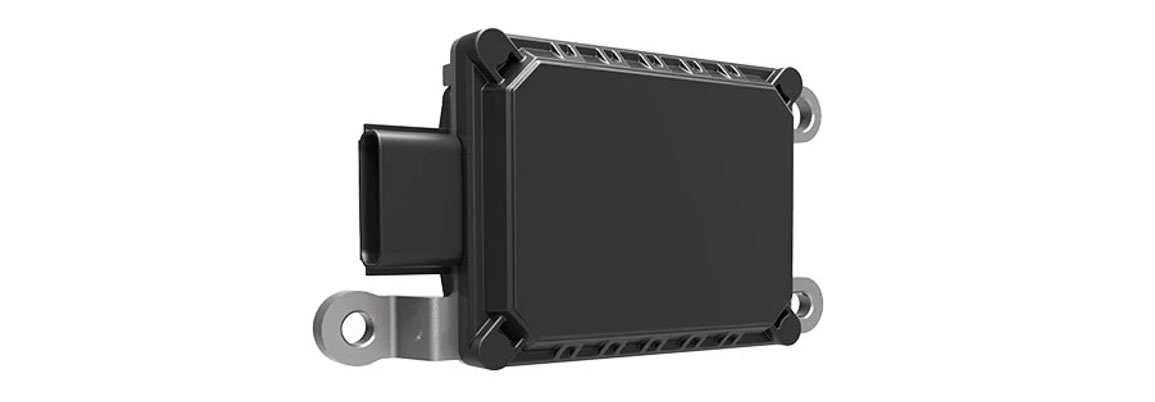
Magna Blends Thermal, Radar Tech for Better Detection

Over 90 per cent of new passenger vehicles in North America have ADAS features like forward collision warning, lane departure warning, and automatic emergency braking. Diversified tier-1 megasupplier Magna is combining the heat-signature detection of thermal technology with imaging radar’s ability to determine an object’s location, speed, and direction, to provide quicker, more reliable environmental analysis under adverse conditions.
The result is a more accurate and robust ADAS, which can boost driver confidence and reduce anxiety in tough driving conditions. Magna says the fusion of thermal and radar technologies offers a significant leap in sophistication and capability, far beyond incremental improvements to current systems.
Conventionally-configured sensor suites can struggle in adverse weather and low-visibility conditions. Magna is addressing those challenges by incorporating thermal imaging and doppler-type radar to improve detection and classification of threats. Magna excels in this area, offering advanced systems that extend perception up to four times beyond headlight range to detect objects up to 200 meters away.
Improving reaction times and safety in adverse conditions is the goal, and thermal and radar technologies cost less than lidar.
DVN comments
Combining thermal 2D imaging with radar 4D imaging can detect stationary objects at long distances where radar resolution falls short. In foggy conditions, the thermal camera can locate crashed vehicles by their heat signatures, unlike lidars or visible-spectrum cameras.
Indie Semiconductor, GlobalFoundries in Car Radar Pact

Indie Semiconductor will partner with GlobalFoundries to develop high-performance radar systems-on-chip (SoC). These, manufactured on GF’s 22FDX® platform, will target 77- and 120-GHz ADAS radars and adjacent industrial applications. Automotive radar adoption is being accelerated by global vehicle safety regulation, new car assessment programs, and consumer demand for convenience features. As a result, new vehicles are being built with more and more radars.
Indie’s 77-GHz SoCs are used in systems for short- and long-range situational awareness and obstacle detection to enable features including forward collision warning, automatic emergency braking, blind spot detection, cross-traffic alerts, and automated parking. Their 77-GHz radar is at an advanced design-in stage with a tier-1 customer supplying multiple automakers.
The 120-GHz SoCs will target in-cabin applications requiring higher resolution and precision over shorter ranges, such as occupant monitoring and detection of vital signs such as heartbeat and respiration. Indie’s 120-GHz SoC supports antenna-in-package designs, enabling smaller systems to be developed without compromising performance, cost or in-cabin aesthetics. First customer samples are already available.
For both product lines, the key challenges were to deliver high performance without compromising hardware, software and system integration, at the lowest total cost. Indie says they have done so. Their design innovation and functional integration of analog, digital, RF, power management, and memory functions are enabled by GF’s automotive-qualified 22-nm fully-depleted silicon-on-insulator process. For ADAS and processing applications that rely on responsive, always-on wireless connectivity, GF’s 22FDX platform offers FinFET-class performance and energy efficiency in a planar technology with state-of-the-art PPA (power, performance, area) and RF performance.
Indie COO Michael Wittman says his company has been working closely with GlobalFoundries for several years; they aim “to keep our customers at the forefront of technology in the increasingly competitive automotive sector, and the combination of Indie’s design innovation and the foundry’s manufacturing leadership will enable safety-critical radar-based ADAS technologies to be deployed cost-effectively across automotive and industrial mobility applications”.
Ed Kaste, GlobalFoundries’ SVP of Ultralow Power CMOS Products, says “Our strategic collaboration with Indie is bringing exciting and innovative product solutions to the automotive and industrial mobility markets,” said Ed Kaste, senior vice president of GF’s ultra-low power CMOS product line. As GF continues to invest in capacity and technology differentiation in our 22FDX platform and build on this partnership for Indie’s next-generation solutions, customers will mutually benefit from GF’s purpose-built, automotive-grade technologies and Indie’s best in class radar design innovation, ultimately delivering the highest-integrated silicon solutions that drive down the total system cost and power consumption for faster and ubiquitous market deployment”.
Advantages of 120- and 240-GHz radars
- All-weather performance (rain, fog, dust…)
- Low power, low cost, low computing requirements; complements camera and lidar
- Large field of view
- Antenna in package: small Footprint (no RF on PCB) for simplified design
- License-free ISM bands
- Increased accuracy; better micro-doppler due to smaller wavelengths in 120- and 240-GHz bands
- Better range resolution due to larger bandwidth
- Range resolution up 3.3mm (theoretical value corresponding to 45-GHz bandwidth in 240-GHz ISM band)
DVN comments
Higher frequencies in the ISM band facilitate the implementation of antenna-on-chip techniques. These techniques simplify PCB design, minimize sensor form factor, and reduce costs. These benefits are vital for applications where external antennas conflict with automotive design standards. For instance, antenna-on-chip can substitute current ultrasonic sensors for ultrashort-range detections during parking maneuvers.


