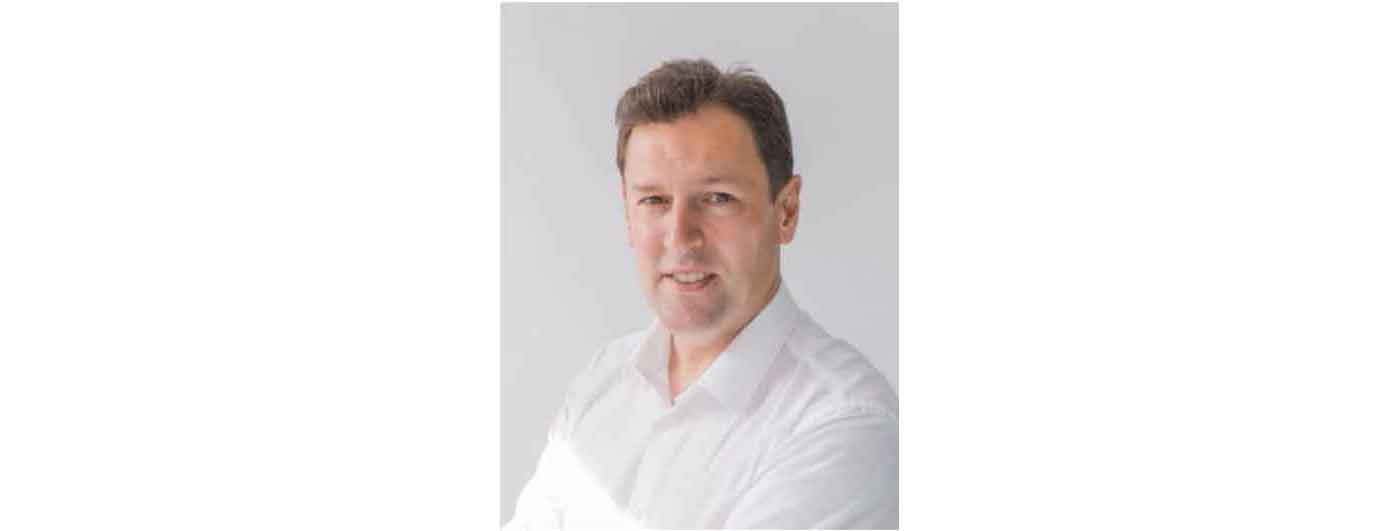
Gregory Poillion is in charge of sales development in the EMEA region for Robosense, with a focus on automotive lidar sensors and perception SaaS. He has a great deal of experience in automotive, having held positions at Blickfeld (VP of Sales), Honeywell (Senior Director of Customer Management), Borg-Warner, Mercedes Benz Technologies, and Valeo. His education includes an executive MBA, ESSEC (Mannheim Business Schools) and a master’s degree in mechanical engineering from Artois Engineering University in France.
DVN: Robosense, founded in 2014, is now a well-known lidar company. What is the company size and competitive position?
Gregory Poillon: As we all know, the lidar market is very competitive and also offers great potential for companies to grow. According to FactMR, the global lidar market is forecast to be nearly $3bn by 2028 and grow at a 14.7% CAGR for the next 6 years. This growth matches what RoboSense is experiencing: increasing interest and adoption in automotive, robotics, and other industries such as infrastructure. We now have approximately 1,600 employees with offices in China, Germany, and the US.
We believe that success hinges on continuous innovation, the ability to mass manufacture cutting-edge products, and deep customer relationships. And RoboSense has proven, time and time again, that we deliver in these areas. In 2023, RoboSense led the lidar industry through significant milestones: we sold over 250,000 sensors, with more than 150,000 sold in the fourth quarter alone. Additionally, we sold a record-breaking 70,000+ sensors in December 2023.
How did we do this?

- Strong technology: RoboSense has 10 years of experience in lidar, but we do not rest on our laurels. We invest heavily in R&D with top engineers from around the globe who have deep experience in lidar and our industries of focus: automotive and robotics. We empower our engineers to do what they do best: develop state-of-the-art products, including our proprietary lidar-on-chip technology that enables fast and efficient product iterations. We continue to bring components in-house, particularly our chips, which removes the reliance on external supply chains, enables us to refine our already proven products, and advances our ability to deliver at scale.
- Mass manufacturing and scalability– RoboSense’s ability to produce high-volume automotive-grade sensors offers a huge advantage over our competition. In fact, we are the first lidar company to mass- manufacture automotive-grade sensors. We have a CNAS-accredited lab and conduct stringent validation testing to ensure product quality and reliability. Our focus on automotive projects has enabled us to develop our mass manufacturing capabilities since these projects are long-term, predictable, and require the highest level of testing. Our experience in the automotive market is a major benefit that is passed down to other industries, such as robotics. By providing innovative, high-performance products to customers who are in the early stage of development, we can help them bring long-term solutions to market with more efficiency and speed.
- A strong customer portfolio—RoboSense began as an automotive-focused company. As of December 2023, RoboSense has obtained 62 vehicle model design wins and successfully assisted 12 automakers and Tier 1 customers in starting the mass production of 24 models. RoboSense has diversified its customer base in the automotive market through its work with North American-based OEMs, Japanese OEMs, Tier 1 companies, and mobility startups. RoboSense is also expanding its reach in the non-automotive industries, including heavy-duty machinery, warehouse robotics, and infrastructure, with 2200 customers in these areas. We are committed to working with all of our customers for critical feedback that enables us to continue innovation, deliver state-of-the-art technology, and advance scalability for all of our customers.
DVN: You’re marketing automotive MEMS lidars with no moving parts. Could you tell us more about the reliability?
G.P.: Our M Platform, including the M1, M1 Plus, and M2 leverages MEMS technology. We became the first company to achieve mass production for automotive-grade solid-state lidar by delivering the M1 to a North American automaker. According to the CIC, we commenced the delivery of mass-produced automotive- grade lidar more than one year ahead of any publicly listed lidar company. Our MEMS-based products have earned industry-wide recognition, and we hold a broad range of certifications, patents, and awards. Our ten years of experience as a global leader in lidar, iterative design processes, and world-class manufacturing deliver proven sensor technologies that our customers trust.
There are several reasons that our MEMS technology is reliable. MEMS lidars do not have moving parts, so they are less prone to wear and tear, resulting in increased durability. Additionally, with fewer moving parts, there’s less need for maintenance or calibration. MEMS lidars are more resistant to shocks and vibrations than those with moving parts, which is key in the automotive industry and critical for rough driving conditions. Our MEMS-based lidar delivers consistent performance over time because there are no mechanical parts that could degrade or drift out of alignment. This reliability ensures that our lidar maintains accurate measurements throughout its operational life. Lastly, our M Platform MEMS lidars are more compact and lightweight than their mechanical counterparts. This streamlined design can lead to easier integration into vehicles and other applications with fewer points of failure.
DVN: What can you tell us about the specifications of your lidars? Do you see differences between the EU market and the Chinese market, is it a problem for you?
G.P.: In January 2024, RoboSense launched the mid-range M2 and the M3, the M Platform’s first long- range lidar. The M2 and M3 are automotive-grade products that expand the company’s robust portfolio of high-performance, cost-effective lidar sensors.
The M3, our first long-range sensor, is a big step forward as we drive mass adoption of our automotive- grade sensors in L3+ vehicles globally. The M3 is a disruptive technology that rivals incumbent long-range 1,550-nm sensors by achieving a 300-meter range at 10-per-cent reflectivity with 940-nm wavelengths. Using 940 nm as opposed to 1,550 nm, we can deliver a more compact, cost-effective, power-efficient sensor. The M3’s advanced 2D scanning technology also enables a 0.05° × 0.05° angular resolution within the region of interest (ROI) to detect smaller objects at longer distances.
Like many of our sensors, the M3 is designed on a modular platform. By enabling upgrades through chip technologies—developed in-house—the form factor, interface, and scanning technology do not change. Customers have the capability to seamlessly upgrade to the next iteration of the sensor when it becomes available without extra design changes or validation.
The M2 is a MEMs-based lidar sensor that achieves a range of up to 200 m at 10 per cent reflectivity. It evolved from the M1 and M1 Plus to deliver improved performance but unchanged form factor, easing pin- to-pin integration for automakers and tier-1 customers. The M Platform’s 2D scanning and a unique “gaze function” for enhanced angular resolution of 0.1° × 0.1° in its region of interest. Developed with more than
90 per cent of the same components as the M1 Plus, the M2 leverages RoboSense’s mass manufacturing capabilities.
DVN: How does your lidar do in bad weather, compared to a camera or a radar?
G.P.: Our lidar systems perform well in adverse weather conditions because they emit their own light source. Therefore, they are less affected by ambient light conditions, like darkness or fog. Additionally, lidar delivers precise, high-resolution data of its environment for accurate object detection. In contrast, cameras require visible light to capture images, making them susceptible to poor visibility conditions caused by fog, heavy rain, or darkness. In these situations, the images captured by cameras may be obscured or distorted, affecting their performance for object detection and recognition tasks. Radar waves can penetrate through these kinds of weather elements, allowing radar systems to detect objects even when visibility is reduced. However, unlike lidar, radar struggles with accurately detecting smaller objects or distinguishing between different types of objects compared to lidar or cameras.
DVN: What about vehicle integration: power, size? Do you see the integration behind windshield as a key factor to speed up the market’s growth?
G.P.: We have worked in partnership with automakers all over the globe to match their integration needs, whether it be behind the windshield or in other areas around the vehicle. Our deep technical expertise and achievements in mass manufacturing enable us to develop lidar that is higher performance, smaller, more power-efficient, and more cost-effective. These are all key factors to meet customer demand and speed up market growth.
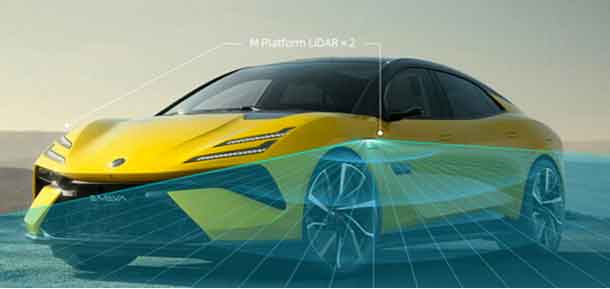
For example, Lotus, a company dedicated to innovative engineering and cutting-edge technologies, chose RoboSense’s automotive-grade M Platform sensors to advance the Emeya’s intelligent driving systems. Enhanced by RoboSense’s lidar technology, the Emeya’s Adaptive Driving Beam technology delivers low- light perception capabilities and helps shield drivers from oncoming glare. In homage to the pop-up headlights of the Lotus Elan, the company’s iconic sports car, RoboSense’s lidar integration in the Emeya highlights the vehicle’s combination of classic design and groundbreaking technology.
DVN: What will be the market size for lidars in China in 2025? What is your expectation for the European and US markets; do you see Robosense becoming a key player in those places?
G.P.: We’re very excited about what we have accomplished in the North American market and the possibilities in front of us. RoboSense was successfully listed on the Hong Kong Stock Exchange in 2024, providing the capital for global expansion and advancing our North American footprint.
Our North American headquarters, which includes our center of excellence, is in Michigan. It is important to us to be at the center of the automotive industry as we deepen partnerships and develop our technology with key automaker customer feedback. In fact, as we mentioned, we became the first and only company to achieve mass production for automotive grade lidar. It feels fitting to note that we did so by delivering our M1 to a North American automaker, demonstrating our growing leadership in the US.
In addition to our Michigan HQ, we have a satellite office in California in the heart of Silicon Valley, where we work with a variety of automotive, mobility, and robotics companies. We are localizing design capabilities and leveraging our rich global manufacturing experience to advance our ability to scale and offer high- quality, cost-effective solutions in the United States. Looking ahead, we will also be bringing multiple products and solutions to the market. These include long-range, mid-range, and short-range lidar, ground truth systems, and perception software.
Recently, we became members of MCity, a public-private mobility research center led by the University of Michigan. This collaboration provides us the opportunity to partner with a diverse community of MCity industry members, government partners, and academia, including Toyota, Ford, Honda, Denso, the U.S. Department of Transportation, and the Michigan Department of Transportation. It is an exciting time as we grow our team and expand our business!
DCN: What about the cost road map for lidars? Do you expect the same curve will apply, with the cost divided by 5 over a decade’s time for blind spot radars?
G.P.: While difficult to predict the exact trajectory, our lidar becoming increasingly more cost-effective. Factors such as improvements in semiconductor manufacturing, optics, and signal processing techniques enable cost reductions in lidar systems. Additionally, increased adoption of lidar technology in various industries, particularly in automotive applications, could drive economies of scale and further cost reductions. Ongoing advancements led by RoboSense as well as market forces will play a significant role in shaping the cost roadmap for lidars in the coming years.
DVN: How do you see the applications and market segments regarding lidar range? Do you see a new market emerging for short range lidars?
G.P.: Our robust portfolio of lidar technology spans ultra-short range to long range. Short-range lidar addresses markets that need precise detection of close objects, including industrial automation, where robots such as autonomous forklifts need to navigate complex indoor environments. Additionally, short- range lidar is required in the automotive industry for applications such as blind spot detection.
Here is an overview of some of the products we offer and they applications they address:
Cutting-edge solid-state lidar:
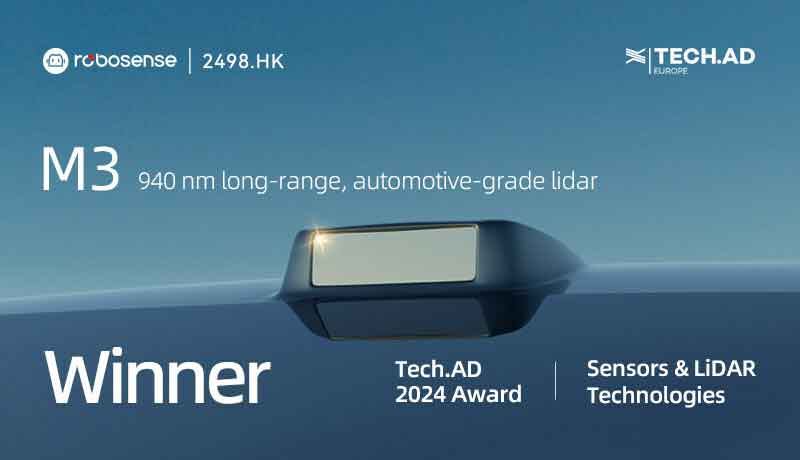
- The M3 is our new long-range automotive grade sensor, designed to meet the L3+ autonomous driving need of automaker and tier-1 customers globally. The compact, affordable M3 is a disruptive technology that rivals incumbent long-range 1,550-nm lidar by using 940-nm wavelength to achieve 300 m range at 10 per cent reflectivity.
- The midrange M2 is the upgraded version of our M1, the world’s first automotive-grade solid-state lidar in mass production. Our M Platform lidar are deployed by automakers globally for advanced driver assistance and autonomy.
- The E1, developed with RoboSense’s proprietary chip technology, provides superior blind spot detection to enhance navigation capabilities and advance safety in vehicles and robots. This compact, solid-state lidar offers 120°H and 90°V FoV and short-range detection of ≤15 cm to eliminate blind spots.
Mechanical lidar innovations:
- The Ruby Plus is an upgraded 128-beam sensor designed for L4 autonomous vehicle commercial operations.
- The Bpearl, with an ultra-wide 360°H × 90°V FoV, delivers precise short-range detection of ≤ 10cm to cover blind spots and enhance navigation capabilities for vehicles and robots.
- The versatile Helios series, including 16- and 32-beam lloffer several vertical FoV options, object detection of ≤ 0.2 m, and have passed critical validation tests to ensure reliability. These sensors are designed to meet a broad range of customer applications, including robotics, intelligent vehicles and V2X.
Advanced software solutions:
- HyperVison is a full-stack system that combines RoboSense lidar and software to deliver comprehensive data analytics for critical decision-making, enabling customers’ development of better, safer solutions.
DVN: What’s the technical future of lidars? Will FMCW technology come soon?
G.P.: RoboSense’s decade of experience in lidar has enabled us to make significant technological advancements, including in resolution, range, size, cost-effectiveness, and development of our proprietary perception software.
As mentioned, we recently launched our M3 sensor, which rivals incumbent long-range 1,550-nm sensors by achieving a 300 m range at 10 per cent reflectivity with 940-nm wavelengths. By using 940 nm, RoboSense delivers a more compact, affordable, and power-efficient sensor for intelligent driving applications.
RoboSense continues our research into various technologies, including FMCW lidar technology. However, FMCW remains immature and has supply chain limitations that our technologies, including flight time, do not.
DVN: Are lidar and imaging radar competing or complementary? Do you think the radar/lidar performance and cost gaps will narrow?
G.P.: Depending on the application, a customer may need redundant sensors. Each has its strengths, and they can be used together to enhance capabilities in various applications such as autonomous vehicles, robots, and intelligent infrastructure.
In terms of performance and cost, we believe that our advancements in lidar technology and the demand for our products are narrowing the gaps between radar and lidar systems. RoboSense’s hyperfocus on R&D contributes to this narrowing, enabling continuous improvements in sensor design, manufacturing processes, and development of other solutions, including our software.


