
California has suspended Cruise’s driverless-car permit, halting the GM self-driving car subsidiary’s robotaxi operations in San Francisco just months after it began. A human driver hit a pedestrian, knocking her into the path of a Cruise robotaxi which stopped overtop of the pedestrian, then decided the road was clear and started forward, dragging the woman along underneath. Additional fuel was added to the controversy by Cruise allegedly providing California with video (from a nearby business’ security cameras) edited to end after the Cruise car stopped, but before it dragged the pedestrian.

Shanghai has established an impressive network of test roads for autonomous driving vehicles, which includes 926 routes covering 1,800 kilometers, placing the city at the forefront of national development. Smart highways are another significant achievement, with a focus on routes like the G15, S32, and G60. Shanghai is diligently working to create unique C-V2X application systems on these routes, bringing new dimensions to modern transportation.

Beijing Public Transport Corporation, along with Yizhuang’s operating company, Foton AUV, and QCraft, secured an intelligent connected vehicle road test permit from the Beijing High-level Automated Driving Demonstration Area (BJHAD). Additionally, they obtained a road test license from the Beijing Traffic Management Bureau. Notably, this marks the first autonomous driving road test license for large public buses in Beijing, signaling the transition from closed-course testing to real-world public transit scenarios.

KargoBot, DiDi’s autonomous freight solution, received a notice for road testing of their factory-assembled L4 autonomous trucks in the Beijing High-level Automated Driving Demonstration Area. Differing from other autonomous driving companies, KargoBot employs a hybrid intelligent operation mode. A human driver operates a lead vehicle equipped with L2 advanced driver-assistance systems (ADAS), guiding multiple L4 autonomous trucks to enhance logistics efficiency across various complex scenarios during short, medium, and long-haul routes.

The Beijing High-level Automated Driving Demonstration Area (BJHAD) recently released a notice regarding the airport highway test roads and test areas. Chinese autonomous driving solution provider WeRide, has taken the lead in obtaining qualifications to test autonomous vehicles on the demonstration zone’s high-speed roads. Today, within the 225-square-kilometer core area of Beijing’s Yizhuang district, citizens can download the WeRide Go App and summon fully autonomous Robotaxis, reaching various destinations like subway stations, central business districts, and large office parks.

TIER IV, who specialize in in open-source AD technology, has achieved L4 certification for their ‘AI Pilot’ system. The certification was obtained at the GLP ALFALINK Sagamihara, a vast logistics campus in the Greater Tokyo area. This accreditation aligns with the stipulations of the Road Transport Vehicle Act. TIER IV intends to realize the Japanese Government’s vision of establishing more than 50 driverless service locations in Japan by 2025, and doubling that figure by 2027.

The J.D. Power U.S. Robotaxi Experience Study indicates a prevailing hesitation among consumers towards the testing and introduction of robotaxis on urban roads. With feedback gathered from both robotaxi riders and those who’ve merely observed them in action (non-riders), the study underscores that only 27 per cent of non-riders feel at ease with these AVs on their roads. Even more telling, only 20 per cent of the national consumer base is comfortable with AV technology being examined in their vicinity.

Cruise, GM, and Honda have announced their intent to launch a driverless ride-hail service in Japan by early 2026. The service will feature the Cruise Origin, an AV co-developed by GM and Honda. While the initial focus will be central Tokyo, the companies aim to expand their reach beyond, contingent upon regulatory approvals. Initial testing is slated for next year, laying the groundwork for a commercial offering by 2026.

Horiba Mira is spearheading the Certus initiative alongside key partners Polestar, IPG Automotive, Connected Places Catapult, and Coventry University. This venture aims to streamline and economize the testing of AD systems. The auto industry has been incurring massive expenses, with billions of Dollars (Euros, Pounds, Yen, Yuan…) spent annually on testing AD systems. Certus aims to provide a solution by targeting a 40-per-cent reduction in these costs.

Ford has received approval in Spain to introduce BlueCruise, their cutting-edge driver assistance system. This expansion follows the system’s successful launch in Great Britain and Germany, bringing hands-free driving to even more European customers. Over 260,000 Ford and Lincoln vehicles worldwide are equipped with BlueCruise, with users having driven more than 200 million hands-free kilometers.

In response to the growing number of pedestrian fatalities in the US, Teledyne FLIR is joining forces with Ansys to work on enhancing ADAS and AV systems with integrated thermal imaging, aiming to augment vehicle perception in adverse weather and light conditions. 7,508 pedestrians were killed in the U.S. by cars and drivers in 2022; 77.1 per cent of these fatal hits happened after dark.

Cruise has teamed up with The University of Michigan Transportation Research Institute (UMTRI) to present a pivotal study to establish a safety benchmark for human driving. The study involved collaboration involved General Motors and the Virginia Tech Transportation Institute (VTTI), and shows certain advanced vehicle technology can reduce collisions by 65 per cent, reduce primary-contributor accidents by 94 per cent, and cut accidents leading to significant injury by 74 per cent.
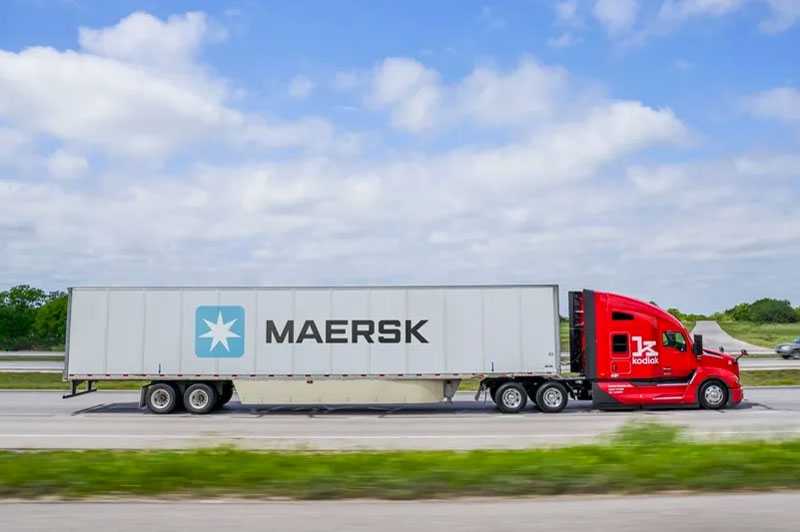
Maersk and Kodiak Robotics have launched the first commercial autonomous trucking lane between Houston and Oklahoma City. The freight lane marks an expansion of the collaboration between Kodiak and Maersk, which began with their first autonomous freight deliveries together in November 2022 as part of Maersk’s Global Innovation Center Program. Kodiak has been delivering eight loads per week, with a safety driver behind the wheel, for Maersk customers since August.


