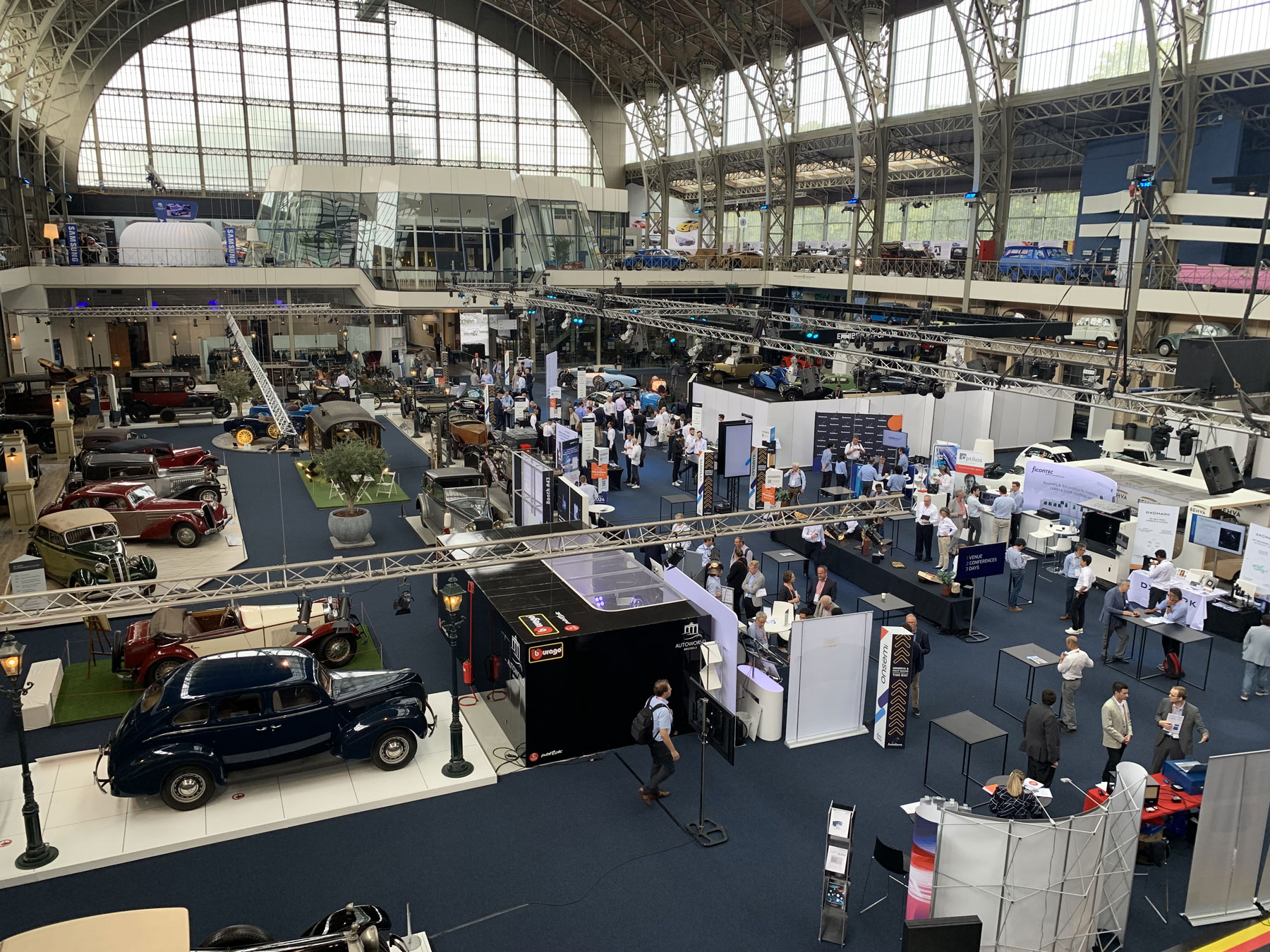
Autosens Brussels, held on 19 to 21September, was a major autonomous-vehicle and sensor technology event. It brought together about 270 automotive industry experts, researchers and policy makers to discuss the latest advances and future challenges of self-driving systems.
One of the main topics discussed at the conference was the integration of sensors into AVs. Participants discussed in detail different sensor technologies—visible-light and thermal cameras, lidars, and radars—and their role in AV perception. Presentations and exhibitions covered challenges related to sensor reliability and accuracy, as well as ways to improve their performance. Here is what we retain from the conference:

Analog Photonics has developed proprietary and patented integrated photonics technology within a 300-mm wafer platform. Wavelengths from the visible to the near-infrared are supported, and integration with CMOS ASIC drivers and lasers enables complex chip-scale systems. They’ve integrated a FMCW lidar to scan the road scene with an OPA structure, and they describe it as giving range up to 225 m @ 10-per-cent albedo; angular resolution of 0.05 × 0.05°, FOV 20°H × 24°V, velocity measured in every pixel, and size 4.5 × 4.0 × 1.5 cm.
Lynred offers infrared detectors covering the entire spectrum, from SWIR to VLWIR. They have longstanding partnerships with Umicore and Saint-Gobain Sekurit to create FIR-transparent windshields for thermal cameras in addition to the visible camera and potentially a NIR lidar. Within this cooperative activity, Saint-Gobain Sekurit has developed crystal-based technology to create a transparent area within the windshield, aligning both the visible and thermal cameras. The crystal meets applicable safety regulations and is integrated while retaining the original performance of the wiper system and the thermal comfort of the passenger compartment. And Lynred provides a 640 × 480 VGA thermal sensor with Umicore lenses, and configures the camera data input with the pedestrian detection algorithm.
This co-development is in response to Euro-NCAP and other vehicle safety initiatives requiring autonomous emergency braking and pedestrian autonomous emergency braking systems to work reliably both day and night, at speeds up to 100 km/h for car-to-car crash avoidance and up to 65 km/h for pedestrian avoidance.

Onsemi: This major silicon supplier demonstrated their Hyperlux automotive image sensor. With a 2.1 µm pixel size, 150-dB ultra high dynamic range and LED flicker mitigation across the full automotive temperature range, the Hyperlux provides high performance and speed and advanced features for ADAS. This technology enables L2+ driving automation.

Sony‘sexhibition showcased advanced AD and automotive safety technologies. The Sony Depth Sensing demonstrator had Sony’s advanced DepthSense IMX556PLR 3D ToF imager; a dashboard-integrated lidar DMS to detect signs of driver fatigue or distraction, and a ceiling-integrated lidar passenger monitoring system to detect misuse of safety belts.

A 3D perception system developped with AGC Wideye was also installed in each B-pillar of the Sony demo car to complete the lateral field of view for overtaking-vehicle detection, blind-spot monitoring, and smart door unlocking.

Teledyne Flir demonstratedthermal cameras that can see through a wide variety of conditions including darkness, sunlight, headlight glare, shadows, and fog. They are especially good at detecting pedestrians, bicyclists, and other vulnerable road users, as well as large animals. Cameras working in the far-IR spectrum can fill the performance gaps where existing vision sensors are challenged. They offer redundancy, and complement existing visible-light, radar, and lidar sensors to improve detection and classification algorithm performance via multispectral sensor fusion.


